Showing posts with label Discovery. Show all posts

Wednesday, July 15, 2015

CERN Announces New Pentaquark God Particle or Satan Paticle Discovery, you decide

""Scientists at the Large Hadron Collider have announced the discovery of a new particle called the pentaquark.

It was first predicted to exist in the 1960s but, much like the Higgs boson particle before it, the pentaquark eluded science for decades until its detection at the LHC.


The discovery, which amounts to a new form of matter, was made by the Hadron Collider’s LHCb experiment.


The findings have been submitted to the journal Physical Review Letters. In 1964, two physicists – Murray Gell Mann and George Zweig – independently proposed the existence of the subatomic particles known as quarks.


They theorised that key properties of the particles known as baryons and mesons were best explained if they were in turn made up of other constituent particles. Zweig coined the term “aces” for the three new hypothesised building blocks, but it was Gell-Mann’s name “quark” that stuck.


This model also allowed for other quark states, such as the pentaquark. This purely theoretical particle was composed of four quarks and an antiquark (the anti-matter equivalent of an ordinary quark).
New states


During the mid-2000s, several teams claimed to have detected pentaquarks, but their discoveries were subsequently undermined by other experiments.


“There is quite a history with pentaquarks, which is also why we were very careful in putting this paper forward,” Patrick Koppenburg, physics co-ordinator for LHCb at Cern, told BBC News.


“It’s just the word ‘pentaquark’ which seems to be cursed somehow because there have been many discoveries that were then superseded by new results that showed that previous ones were actually fluctuations and not real signals.""


Monday, February 23, 2015

Sidon Ancient Secret Room Unearthed at Frères Archaeological Site Temple in Lebanon

""SIDON, Lebanon: Dozens of workers were busy covering old Sidon’s Frères archaeological site Monday, to protect a major new discovery unearthed by a delegation from the British Museum.

“A small contingent of the British Museum/Directorate General of Antiquities of Lebanon team of archaeologists discovered a new deeply concealed room,” read a statement released by the delegation.

The newly discovered monumental room is believed to be an extension of the underground Temple of Sidon, which dates back to the Bronze Age.
This finding comes as workers prepare the foundations of a new national museum, which will be established beside the archaeological site. Construction of the museum led to urgent excavations at the site last month.

Ten years ago, the delegation discovered an underground “holy of holies” room, dating back to 1300 B.C., where ancient residents are believed to have worshipped their gods. The newly discovered room was found adjacent to it, and is thought to be an extension of the site’s temple. It is believed to have been used by high-status members of the community.
Claude Serhal Doumit, head of the delegation, described the finding as significant, and said the room had been concealed by later developments built over it.
“Sealed by the imposition of a Persian period building constructed on top of it, this new room is of the highest importance in terms of its monumentality and untouched pottery material, both [domestically produced] and imported from Cyprus and Mycenae,” read a statement released by the delegation.

The British Museum delegation conducted excavations at the Frères site for nearly 17 years, after receiving approval from the Directorate General of Antiquities.
The room’s walls were constructed with monumental stones to a height of 4.5 meters, while the floor of subterranean room would have been 7.5 meters below street level. Archaeologists unearthed a number of artifacts inside.

“Wooden material, pottery and utensils for ritual celebrations used for eating, drinking and mixing fluids were found,” Doumit told The Daily Star.
Sidon MP Bahia Hariri hailed the new discovery, saying it helped reveal the rich history of the ancient city.

Hariri, who visited the Frères archaeological site Monday, praised the excavation work carried out by the Directorate General of Antiquities’ Sidon office and the British Museum delegation.

Sidon is a repository of many ruins, which reflect the various civilizations and cultures that inhabited the city. Hariri believes that the finding will contribute to the city’s new museum, which in turn will revive south Lebanon’s economy and culturally.""

Lost and Found:

Thursday, January 8, 2015

NEO Neurophone CES 2015 Patrick Flanagan Sneak Peak


""The NEO Neurophone is not a smart phone.  Rather, the brand new 2015 NEO Neurophone is famed inventor Dr. Patrick Flanagan's profound time-tested techno-meditation device that uses blissful ultrasonic waves to soothe and center your mind and allow the possibilty to make you smarter.


NEO is Easy to Use
Place Dr. Flanagan's the lightweight easy to use NEO Neurophone transducers on your forehead, switch on the Neurophone and gentle ultrasonic waves waft into your brain, whisking you to new levels of awareness, balancing your left/right brain hemispheres and thus -- for many -- boosting IQ.

Sound like the latest sci-fi opening in theaters?  Nope, this dream is completely real.  The NEO Neurophone is the newest and most advanced model in a long series of Neurophones dating all the way back to the 50s when sci-fi was all the rage.


Ultrasonic waves are extremely beneficial to the human brain.  If you google "brain ultrasound", you'll see universities only just now catching on to how great ultrasonics are for the mind, while a child prodigy named Patrick Flanagan, only thirteen years old when THE FLY and ATTACK OF THE 50 FOOT WOMAN played as double features at the local Oklahoma drive-in, had already invented his first Neurophone.

Since 1958, Dr. Patrick Flanagan and later his cutting edge company Phi Sciences that he founded in 1987, have been refining his profound Neurophone discovery, first inspired by a 1911 Hugo Gernsback science fiction tale about a sleep learning tool.   Patrick's Neurophone  impressed Hugo (for whom the prestigious Hugo Nebula Awards are named) deeply enough to extend a personal thank you to Dr. Flanangan for carrying out one of Gernsback's visions of the future, which included the prediction of television.


Got Prize Deliveries and NEO Questions?
Lucky for you, this campaign is not your typical Indiegogo startup.  It's backed by an excellent service team at Patrick Flanagan's PhiSciencs established 1987.  Their office hours 9-4 PM mounitain time.  Unless the lines are busy from the funder traffic, a real PhiSciences person, not a robot, will take your call at 928-634-2668 or feel to email them at help@phisciences.com.
Intelligence Everywhere""


Tuesday, January 6, 2015

Within the Grand Canyon, an Enigmatic System of Tunnels Leading to Evidence of an Ancient Egyptian Voyage to America?


""The original story goes that the team found an underground network of tunnels, high above the Colorado River, containing various ancient artefacts, statues and even mummies. A major discovery, no doubt about it. Impossible to slip off the archaeological radar. Still, the Smithsonian Institute will report it has no records on the subject. So what happened? To find out, there is only one guide: the article itself. Though the article was anonymous, it did identify some of the archaeologists involved: “under the direction of Prof. S. A. Jordan", with Smithsonian-backed adventurer G. E. Kinkaid, who then relates his findings.
But the story gets weirder when the Smithsonian stated that it had no Kinkaid or Jordan on record. In one enquiry from 2000, the institution replied: “The Smithsonian Institution has received many questions about an article in the April 5, 1909 Phoenix Gazette about G. E. Kincaid and his discovery of a 'great underground citadel' in the Grand Canyon, hewn by an ancient race 'of oriental origin, possibly from Egypt.' […] The Smithsonian's Department of Anthropology, has searched its files without finding any mention of a Professor Jordan, Kincaid, or a lost Egyptian civilization in Arizona. Nevertheless, the story continues to be repeated in books and articles.” There is room for a cover-up, of course, as some have argued. The files do not necessarily have to set within that department’s and the reference to the Phoenix Gazette rather than Arizona Gazette could be a simple error, or an escape valve that is so often present in official replies engineered to debunk. Stories like “the CIA Division X has no record” often means that Division Y is the one who has that record.


So, there is no Professor Jordan, and Kinkaid himself was more than difficult to pin down. However, on March 12 of the same year, the Gazette had reported on an earlier phase of Kincaid's adventure: “G. E. Kincaid Reaches Yuma.” Here, Kinkaid is identified as being from “Lewiston, Idaho”; he “arrived in Yuma after a trip from Green River, Wyoming, down the entire course of the Colorado River. He is the second man to make this journey and came alone in a small skiff, stopping at his pleasure to investigate the surrounding country. He left Green River in October having a small covered boat with oars, and carrying a fine camera, with which he secured over 700 views of the river and canyons which were unsurpassed. Mr. Kincaid says one of the most interesting features of the trip was passing through the sluiceways at Laguna dam. He made this perilous passage with only the loss of an oar." The account is factual enough and seems to just that: fact. The article concludes: "Some interesting archaeological discoveries were unearthed and altogether the trip was of such interest that he will repeat it next winter in the company of friends." Less than a month later, the same newspaper seemed to continue their story where they had left it off: Kinkaid was now talking about his “interesting archaeological discoveries”, which consisted out of a series of tunnels and passages with a cross chamber near the entrance, containing a statue: "The idol almost resembles Buddha, though the scientists are not certain as to what religious worship it represents. Taking into consideration everything found thus far, it is possible that this worship most resembles the ancient people of Tibet." He also stated that he had found an unknown gray metal, resembling platinum, as well as tiny carved heads, scattered on the floor. Urns bore "mysterious hieroglyphics, the key to which the Smithsonian Institute hopes yet to discover." In another room he found mummies: "Some of the mummies are covered with clay, and all are wrapped in a bark fabric."

 
Again, the account is quite factual. Idols “resemble” Buddha, rather than “are” Buddha. The worship “resembles” that of Tibet, not “is”… Kinkaid is trying to use analogies to explain his discovery. It is the anonymous author of the article who makes the connection with ancient Egypt and lets his mind float to one of the biggest discoveries of all time. Still, the newspaper apparently never followed up the story.
Though the Smithsonian involvement is therefore either proof of a cover-up (as some have claimed) or they are telling the truth, this does not mean that the entire story is a hoax, or that the newspaper fabricated the story. “Kinkaid” may have existed, and may have inflated his credentials. Alternatively, he may have made the entire thing up. It may be a hoax, but by whom?
The newspaper reported rather factually about it. It may have been their hoax, in an effort to sell more papers, but if so, you would expect to hear more about it, including announcements like “more to come in the following edition”, whetting the public’s appetite.


The anonymous author may have fabricated the story, as he perhaps could not fill the entire newspaper. Perhaps… Which leaves Kinkaid. In his first account, we read how he stated that he has made archaeological discoveries, but these seem to have occurred all on his own. Furthermore, it is clear that he has made numerous photographs. We need to stress that the discovery of the underground network occurred before the first story was written. In fact, it appears that the discovery was made roughly four to six months prior the article. But in the second story, we learn Kinkaid apparently did not travel alone, but was helped by a professor from the Smithsonian. Also, it seems he did not make any photograph of his discovery. Though he claims that the access was very difficult, you would expect Kinkaid to have made some photographs of the general area.
In the Phoenix (Arizona) Gazette article of April 5, 1909 it is stated that Kinkaid "brought the story" of the "underground citadel" "to the city" (Phoenix and the Gazette) "yesterday" (April 4, 1909) after having "discovered" the site "several months ago". It is clear that as far as the newspaper was involved, they were reporting on recent information. But why Kinkaid had not included his discovery in his original account, back in March, is more enigmatic. Even though the newspaper may have wanted to wait to run it, it is clear that the delay is entirely Kinkaid’s.


With no traces of Kinkaid, though, did he actually exist? Jack Andrews has underlined that Kinkaid may have been a real person. In the newspaper report, Kinkaid mentions that he was “looking for mineral”: "I was journeying down the Colorado river in a boat, alone, looking for mineral." The Canyon was a known source of minerals, including copper. But, in 1908, the year of Kinkaid’s expedition, President Theodore Roosevelt had made the Canyon in a National Forest, closing it for any mining or prospecting activity. Andrews has furthermore shown that the area in which he had allegedly found the cave was a well-known area for prospecting. So he could be real… even though perhaps the newspaper got his name wrong… A spelling mistake could send any researcher off the right track, resulting in the conclusion that a person did not exist.
So, what about the cave? It is a fact that the Canyon has many holes and caves, most of which are discovered by hikers. A clear favourite for an Egyptian connection is the area around Ninety-four Mile Creek and Trinity Creek has sites with names like Isis Temple, Tower of Set, Tower of Ra, Horus Temple, Osiris Temple, etc. In the Haunted Canyon area are such names as the Cheops Pyramid, the Buddha Cloister, Buddha Temple, Manu Temple and Shiva Temple.


One book, Ancient Secret of The Flower of Life (Vol. II, page 302), claims that two backpackers, on their way to Isis Temple, found a pyramid, made from the native rock. Once at Isis Temple, they claimed to have seen several cave entrances. They stated that the cave entrances were at a height of 800 feet, and the two climbed up, hoping to get into what looked like the most promising cave. But instead they found it had been sealed off with rocks. They felt the entrance was man made and that there was a 6 foot circular pattern hewn into the ceiling.
It is unknown whether this is an actual discovery, or more “talk”. Irrelevant, Isis Temple is more than 40 miles from the location given in the newspaper article. Furthermore, it is but one of numerous buttes in the Grand Canyon named after ancient Egyptian, Greek, Hindu, Chinese and Nordic gods and goddesses. The origin of the rather esoteric naming is nearly as mysterious as the canyon itself, and has given rise to more than a little speculation as to what early explorers may have found there. But it may also be a perfect memory of its time, when there was a major fascination with all things Egyptian-Indian.""


Plenty More To Investigate Here:

Friday, October 21, 2011

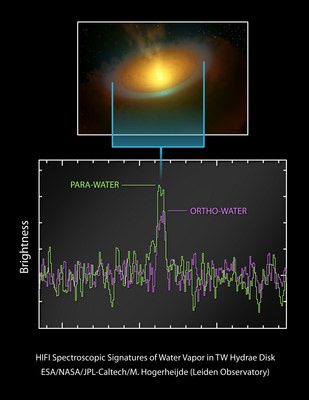
TW Hydrae Star System First Icy Planet-Forming-Disc Observed Hints at Potential Source of Earth's Ocean Waters


""For the first time, astronomers have found a planet-forming disc around a star that is awash with frozen water. The discovery adds credence to the idea that Earth got its water from comets – especially as the disc seems to contain enough water to fill Earth's oceans thousands of times over.

Hot water vapour has previously been detected in the inner part of the planet-forming discs of nascent, alien solar systems. But this is too close to the central star to be incorporated into the forming planets.

By contrast, the new observations are of water in the form of ice grains, which can exist only in the frigid outer reaches of a planet-forming disc. It is there that they can ultimately coalesce into planets and comets.

Before planets form, the disc of material surrounding young stars is mostly gas. Astronomers can probe the contents of that gas by analysing the spectra of the light it emits. Earlier observations had found organic materials like carbon monoxide and cyanide in such discs, but because Earth's own atmosphere is so damp, it interferes with the detection of alien water from the ground.""


http://www.newscientist.com/article/dn21076-first-icy-stardisc-hints-at-source-of-earths-water.html

Wednesday, October 19, 2011

Archaeologists Discover Early Blade Production Evidence For Cutting Tools & Battle Weapons Aged 400,000 Years Old!: The Product of a Sophisticated "Production Line."


""researchers at Tel Aviv University have uncovered evidence which shows that "modern" blade production was also an element of Amudian industry during the late Lower Paleolithic period, 200,000-400,000 years ago as part of the Acheulo-Yabrudian cultural complex""

http://www.physorg.com/news/2011-10-archaeologists-blade-production-earlier-thought.html

All My Verses Chemistry 4 Conscious Eggs ********* ALCHemYEGG AUMniVERSE