Showing posts with label Robotic. Show all posts

Friday, March 27, 2015

New Age of Printing Bionic Nature Creations with 3D Printing

""Bionic ants and butterflies produced on a 3D printer are just as beautiful — and industrious — as their counterparts in the natural world.

Research efforts into minitaurization, practical adaptation of nature's tactics and functional integration with technology by the Bionic Learning Network will be showcased. The research network links German electronics company Festo to universities, institutes, development companies and private inventors as they seek creative solutions and test new technologies and production methods.

BionicANTs borrow not just from the physical characteristics of ants, but the design also incorporates many of the behavioral features of the highly social insects. The insect-inspired devices are slightly over 5 inches long and weigh just over 1 ounce each.

The artificial ants are created on a 3D printer, forming both the basic structure of the device and electrical connections in a single pass. Each artificial ant is equipped with a small video camera, providing a sense of "sight" for the robotic insects. The robotic insects recharge their internal batteries by placing their antennae against a charging station.
Piezo technology is used to drive bending actuators in the devices, which provide the joints within limbs, allowing the device to propel itself along surfaces. This system also uses little electricity, essential for operating time of the robots.

Autonomous Networking Technologies (ANTs) carry out collective activities in much the same ways as their counterparts in the natural world. The ants use a wireless signal to communicate with each other to carry out their tasks.

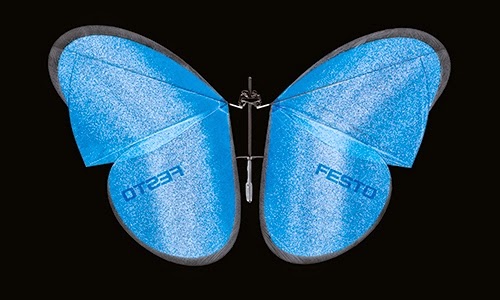
eMotionButterflies also use a similar system to carry out social activities, including collective flying. These ultralight flying objects take to the air inside a specially designed room, where 10 infrared cameras detect the position and movement of the artificial butterflies. This information is relayed to a central computer, which coordinates motions of the devices.

"The eMotionButterflies impress with an intelligently employed mechanical system and the smallest possible power units in the tightest space. The reduced use of materials enables the true-to-nature flying behavior," Festo managers reported on the company website.""

Bionic Creations:


Wednesday, January 14, 2015

Advanced Photographic Tools Unmanned Autonomous Underwater Robotic Vehicles Uncover Deep-sea Ecosystem Diversity at ‘Landscape’ Scales

""Scientists at the National Oceanography Centre (NOC) have used advanced photographic tools in an unmanned Autonomous Underwater Vehicle (AUV) to make major advancements in estimating deep-sea ecosystem diversity at 'landscape' scales.
By using a camera on the Autosub6000 AUV to take a continuous stream of high resolution photographs of life on the sea floor, this new method revealed a tenfold increase in the precision of deep sea ecosystem diversity estimates relative to the use of scientific trawling. Autosub6000 was developed by the NOC as part of an ongoing project. This research showed that Anemones were the most abundant animal on the sea floor, information that has been previously missed from trawling because they became damaged in the nets and rendered unrecognisable.
Dr Kirsty Morris, the lead author of this research, published in Limnology and Oceanography: Methods, said "This is an important step towards the automated imaging of the deep sea, which is essential for understanding the complexity of seafloor biodiversity and its future management"

Once the images were taken they were analysed to identify the types of creatures seen, calculate their relative abundances and estimate their size relative to the image pixels. This allows for an overall estimate of the biomass to be calculated and compared with later/earlier images in order to monitor how these ecosystems change over time.
As climate change and potential exploitive pressure of seafloor resources impact the ocean, it is increasingly important to better document deep sea marine biodiversity and ecosystems. Currently trawling is one of the most common methods of assessing what creatures live in these habitats; however trawling has drawbacks in terms of poor accuracy and a bias in sampling seafloor biota. The new method, developed at the NOC, will substantially improve the accuracy and efficiency of sea floor surveying.
This method was developed and tested as part of the NERC funded AESA (Autonomous Ecological Surveying of the Abyss) project. It is currently being used to map the proposed marine conservation zone, know as Haig-Fras, as well as to estimate the seafloor carbon dynamics within the vicinity. This project will involve evaluating the role of habitat and sediment type, as well as discovering which animals live there.
Dr Henry Ruhl, co-ordinator of the AESA project, said "We are creating photographic maps of animals on the seafloor, which can scale up to the size of cities. This allows us to understand links between ecology, ecological functioning, and human impact in a way that was not previously feasible.""


Source Content Material Site:

Monday, January 12, 2015

SpaceX's Robotic Dragon Resupply Spacecraft Arrives at International Space Station with Groceries


""SpaceX's robotic Dragon resupply spacecraft has arrived at the International Space Station after a two-day orbital chase.
NASA astronaut Barry "Butch" Wilmore, commander of the station's current Expedition 42, grappled Dragon using the orbiting outpost's huge robotic arm at 5:54 a.m. EST (1054 GMT) on Monday (Jan. 12). Crew members will next install Dragon on the Earth-facing port of the station's Harmony module.
There are few jobs cooler than being an astronaut. And now is a better time than ever to get a job in the space industry! Find out how.
Once installation is complete, astronauts will begin offloading the 5,200 pounds (2,360 kilograms) of food, spare parts and scientific experiments that Dragon brought up on this mission, the fifth of 12 unmanned cargo flights SpaceX plans to fly to the space station under a $1.6 billion deal with NASA. [See photos from SpaceX's fifth Dragon cargo launch]
SpaceX launched the Dragon capsule early Saturday (Jan. 10) atop a Falcon 9 rocket that lifted off from Florida's Cape Canaveral Air Force Station. After the rocket sent Dragon on its way, SpaceX attempted to bring the Falcon 9's first stage back to Earth for a pinpoint landing on an "autonomous spaceport drone ship" in the Atlantic Ocean, as part of the company's effort to develop reusable-rocket technology.
The rocket stage came down on target but hit the drone ship too hard Saturday. SpaceX will try the bold maneuver again on future launches, company representatives said.
Dragon is unmanned, but the capsule did bring a number of living passengers up to the orbiting lab. For example, it hauled an experiment that will look at how microgravity affects the wound-healing abilities of flatworms, and two others that will study how plants grow in space.""
Main Article:

All My Verses Chemistry 4 Conscious Eggs ********* ALCHemYEGG AUMniVERSE