Showing posts with label Hardware. Show all posts

Thursday, June 11, 2015

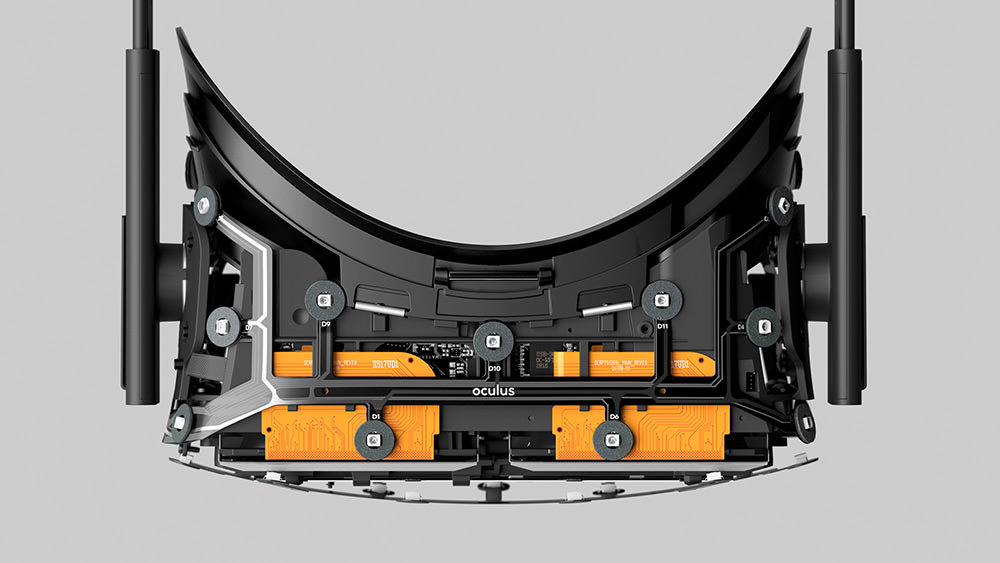
Oculus Rift CV1 Consumer Virtual Reality HUD Sensation Debuts on E3 Press Conference with Latest Hardware Breakthroughs

""The Facebook-owned virtual reality company Oculus today showed off a streamlined version of its gaming headset, Rift, that will be available to consumers in the first quarter of 2016.
Oculus first excited the gaming world three years ago when it launched a Kickstarter campaign to finance the development of its headset. It easily blew past its $250,000 crowdfunding goal and ended up raising $2.4 million. Then in 2014, Facebook acquired the startup for $2 billion, based on CEO Mark Zuckerberg’s belief that virtual reality will represent the next major computing platform.
“Oculus Rift is going to deliver the magic of presence,” Oculus CEO Brendan Iribe said today at a press event in San Francisco. “This isn’t science fiction. This is reality, and it’s happening today.”
Oculus has yet to reveal the cost of Rift, but Iribe said it will be at an “affordable price.” As part of a partnership with Xbox, Oculus Rift will ship with a wireless Xbox One controller and be able to stream Xbox One games.
The company also introduced new handheld sensors called Oculus Touch.
“One of the first things people do [when they put on Rift] is they reach out to this virtual world,” said Oculus founder Palmer Luckey. Touch will be able to recognize hand gestures, such as waving or pointing, and enable people to hold and interact with virtual objects, such as a gun in a shooting game. It will be sold separately and available shortly after Rift launches.
Revealed ahead of the E3 gaming conference in Los Angeles next week, the new headset has been slimmed down and wrapped in fabric so it’s more comfortable for people to hold and wear. The company says it has also improved eye tracking so the experience is less jarring and nauseating for wearers.
“Really, for the first time it feels like a consumer product,” Iribe said. But while Oculus is finally getting ready to ship its first consumer product, it’s still far from achieving Zuckerberg’s vision of becoming a mainstream computing platform. “I think that’s going to realistically take a while,” Iribe tells Quartz. “I do absolutely think that will happen, but it will just take time.""


Wednesday, May 6, 2015

3D Printer Hype for Multitudes of Libraries in the States

""At hundreds of libraries across the U.S., 3-D printers can sometimes be heard whirring in the background, part of an effort to encourage interest in the new technology and foster DIY "maker spaces."
In some libraries, officials have begun to set restrictions on the 3-D printers amid concerns about how they'll be used.
At the University City Public Library in St. Louis, Patrick Wall recently printed a green plastic sword from the game Minecraft.
He runs this library and was demonstrating its new 3-D printer for a group of kids and adults. The play sword took close to 1 1/2 hours to print, Wall says.
The printer is roughly the size of a microwave with an open space in the middle. A coil of filament feeds an extruder that moves back and forth inside, dabbing molten plastic into layers that harden.
The 3-D printer, a 3-D scanner and filament cost about $4,500, Wall says.
University City was the first of two public libraries in the St. Louis area to set up 3-D printers for public use. But, according to the American Library Association, more than 250 libraries across the country that have one.
"It's actually part of a larger trend," says the ALA's Sari Feldman. 3-D printers are just the newest example of the interactive spaces that libraries are becoming for their communities, she says.
"So, where once we thought of libraries as places where we had things for people, now we really do things for people — or do things with people," Feldman says.
She says libraries large and small across the U.S. are setting up so-called "maker spaces," offering increasingly sophisticated hardware and software, including studio production equipment, design software and in some cases, even laser cutters.
But Feldman says the possibilities that come with cheap, user-friendly 3-D printers have also created a new gray area in setting library policy.
"There are many legal and intellectual freedom issues that need to be addressed when you make 3-D printers freely available for public use," she says.
For instance, the same technology that can print a plastic Minecraft sword is also capable of printing plastic gun parts or other items.
The ALA has recommended guidelines for libraries to address concerns about safety, access and liability. But some local libraries have established rules on their own.
At the Pope County Library System in central Arkansas, new restrictions have been placed on its two printers. They include printing objects that are prohibited by law, or deemed obscene or otherwise inappropriate.
Adult and Teen Services Librarian Sherry Simpson says there were just too many unknowns.
"We want to inspire their interest in design and we want them to bring their creations to life. However, some creations probably don't need to see life through the library," she says.
Like most other libraries, University City's currently has no specific limits on using its 3-D printer. Director Patrick Wall says it falls under the library's general policy that applies to 2-D printers and other services and materials.""

Wednesday, January 7, 2015

Hardware Entering Key Test Phase for the James Webb Space Telescope Flagship Program Project

James Webb Space Telescope 

hardware entering key test phase

no alt
""An array of high tech instruments are being put through their paces ahead of becoming part of the James Webb Space Telescope (JWST). The successor to the Hubble Space Telescope – JWST engineers are currently testing hardware to ensure it will be able to function properly 1.5 million miles from Earth. The spacecraft is preparing for a launch late in 2018.

JWST:

Set for launch in October, 2018 via an Ariane 5 launch vehicle, JWST will be the scientific successor to the Hubble and Spitzer Space Telescopes.
The hugely expensive project came close to cancellation in 2011, after the program suffered with schedule slips and budget overruns. With $3 billion already spent on the JWST program, along with 75 percent of its hardware already in production, the telescope was given a stay of execution, albeit with costs capped at $8 billion.
It was originally forecast to cost just $1.6 billion.
JWSTThe project has NASA, ESA and the CSA as the lead partners, but includes a collaboration of about 17 countries in total.
To be located 1.5 million kilometers from Earth at the Earth-Sun Lagrangian point L2, JWST’s 6.5-meter diameter primary mirror – a gold coated beryllium reflector – and four specialized instruments ensure the spacecraft will provide unprecedented resolution and sensitivity from long-wavelength visible to the mid-infrared.
Unlike Hubble’s single monolithic primary mirror, JWST’s primary mirror is made up of 18 individual, adjustable segments that will be aligned in space.
2015-01-07 19_56_13-nircam1.jpg (720×653)The spacecraft’s array of instrumentation is currently being tested to ensure it can survive the extremes of space, with the most recent test involving the Near Infrared Camera (NIRCam) instrument, which is the primary imager covering the infrared wavelength range 0.6 to 5 microns.
NIRCam will detect light from the earliest stars and galaxies in the process of formation, the population of stars in nearby galaxies, as well as young stars in the Milky Way and Kuiper Belt objects.
NIRCam is equipped with coronagraphs, instruments that allow astronomers to take pictures of very faint objects around a central bright object, like stellar systems. Its coronagraphs work by blocking a brighter object’s light, making it possible to view the dimmer object nearby.
2015-01-07 19_55_13-Satnews Publishers_ Daily Satellite NewsWith the coronagraphs, astronomers hope to determine the characteristics of planets orbiting nearby stars, which is of great interest over recent years,thanks to the discoveries made by NASA’s Kepler spacecraft. ""

Find out more @ nasaspaceflight.com

Thursday, January 1, 2015

Web VR Architectures Ignite Software Developers to Port Virtual Worlds for Sharing and Streaming on the Internet


Virtual Reality Comes to the Web—

Maybe for Real This Time in 2015


""Get ready to take the stage with Paul McCartney. If that’s not your thing, you can test-drive the latest SUV before it's available in showrooms or experience a movie as though you're in the scene. That's been the promise of virtual reality (VR) for years, although stepping into an immersive three-dimensional virtual world has always required expensive stereoscopic head-mounted displays and other specialized equipment.

A new, more accessible form of virtual reality delivered via the Web promises to let people experience digital worlds in 3-D using head-mounted displays connected to a variety of browser-enabled devices. Web VR is expected to offer the ability to move you from one immersive experience to another with a click of the mouse, touch of the screen or nod of the head. Web VR will let software developers port their virtual worlds to the Web, making them available for most VR hardware.


Google and Mozilla are setting these wheels in motion within the next month or so when they deliver updated Chrome and Firefox browsers that support Web VR. Facebook’s $2-billion acquisition of VR headset maker Oculus VR earlier this year and the release of relatively inexpensive headsets from Samsung and Google provide further evidence that Web VR could be ready for wider use.

VR for the masses
Web VR has been around since the early 1990s, when virtual reality modeling language, or VRML, aimed to allow the creation of virtual worlds—such as Second Life—linked together via the Web. But VRML could only be rendered using heavy-duty graphics workstations more likely found in a computer science lab or a data center than in one’s home. Although work on VRML continues, this first attempt was way ahead of the hardware.


The availability of content will largely define Web VR’s success. Businesses have already begun buying into the concept of immersive advertising, thanks in large part to Facebook’s investment in Oculus. Beer brewery Dos Equis created a promo that places you at a fancy party with “The most interesting man in the world.” To promote its new XC90 SUV Volvo created Volvo Reality, a virtual test drive and look at the car. Meanwhile the Sundance Film Festival's 2015 New Frontiers program, which showcases nontraditional and multimedia storytelling, will offer nine virtual reality works employing a variety of technologies. And Jaunt's virtual Paul McCartney app lets you walk around McCartney's piano, peering over his shoulder or looking into his eyes as he sings "Live and Let Die."

All of these projects are app-based: Just like a smartphone app, you have to find them and download them individually to your computer or phone—and most of them will run on only one kind of headset. Available gadgets include the still-in-beta Oculus Rift (targeted more at programmers than the average user) and Samsung Gear VR. Google's DIY Cardboard is an odd entry; the company offers directions to help you make a cardboard headset with lenses that you put over a smartphone to see VR content.""


Original Article Continued Here: 

All My Verses Chemistry 4 Conscious Eggs ********* ALCHemYEGG AUMniVERSE