Showing posts with label Researchers. Show all posts

Wednesday, November 2, 2011

Holst Centre, Eindhoven Researchers Create New Form of Lighting Made With Thin Flexible Sheets of Organic Light-Emitting Diodes (OLEDs) Using Newspaper-Style "Roll-to-Roll" Printing Process


""These bendable materials could oust the conventional light bulb and revolutionize the way we illuminate our surroundings, being used for everything from lighting tiles and strips in homes and offices to windows that can simulate sunrise and sunset.

Rather than the traditional solid, "inorganic" LEDs that we are used to seeing in display signs, traffic lights and car indicators, OLEDs can be easily dissolved in a solvent and so sprayed onto a roll of thin, flexible, plastic foil in the same way that newspapers are printed.

"Many companies recognize the potential of OLEDs and are investing heavily in research and development in the hope that when this technology finally takes off, they will be in pole position to take advantage," Blom and Van Mol write.

The bottom layer of an OLED, which acts as a support, is a flexible material such as a polymer foil that has the electrodes and the light-emitting layer sandwiched on top to make up the complete device. Each layer is between 5 and 200 nanometres thick.

Traditional LEDs have so far failed to become a viable alternative to light bulbs because, despite being highly efficient, they have to be fabricated in clean rooms and so are expensive to make.""


Tuesday, October 18, 2011

Seeing Through Concrete Walls: Researchers at MIT’s Lincoln Lab Have Developed New Radar Technology That provides Real-Time Video of What’s Going on Behind Solid Walls


""The ability to see through walls is no longer the stuff of science fiction, thanks to new radar technology developed at MIT’s Lincoln Laboratory.

Much as humans and other animals see via waves of visible light that bounce off objects and then strike our eyes’ retinas, radar “sees” by sending out radio waves that bounce off targets and return to the radar’s receivers. But just as light can’t pass through solid objects in quantities large enough for the eye to detect, it’s hard to build radar that can penetrate walls well enough to show what’s happening behind. Now, Lincoln Lab researchers have built a system that can see through walls from some distance away, giving an instantaneous picture of the activity on the other side.

The researchers’ device is an unassuming array of antenna arranged into two rows — eight receiving elements on top, 13 transmitting ones below — and some computing equipment, all mounted onto a movable cart. But it has powerful implications for military operations, especially “urban combat situations,” says Gregory Charvat, technical staff at Lincoln Lab and the leader of the project. ""


http://web.mit.edu/newsoffice/2011/ll-seeing-through-walls-1018.html

Monday, October 17, 2011

Sea Levels Will Continue To Rise For 500 Years: Perhaps One of the Most Catastrophic Consequences of Rising Temperatures

 ""Rising sea levels in the coming centuries is perhaps one of the most catastrophic consequences of rising temperatures. Massive economic costs, social consequences and forced migrations could result from global warming. But how frightening of times are we facing? Researchers from the Niels Bohr Institute are part of a team that has calculated the long-term outlook for rising sea levels in relation to the emission of greenhouse gases and pollution of the atmosphere using climate models. The results have been published in the scientific journal Global and Planetary Change.

"Based on the current situation we have projected changes in sea level 500 years into the future. We are not looking at what is happening with the climate, but are focusing exclusively on sea levels", explains Aslak Grinsted, a researcher at the Centre for Ice and Climate, the Niels Bohr Institute at the University of Copenhagen. 


Model based on actual measurements 

He has developed a model in collaboration with researchers from England and China that is based on what happens with the emission of greenhouse gases and aerosols and the pollution of the atmosphere. Their model has been adjusted backwards to the actual measurements and was then used to predict the outlook for rising sea levels. 

The research group has made calculations for four scenarios:
A pessimistic one, where the emissions continue to increase. This will mean that sea levels will rise 1.1 meters by the year 2100 and will have risen 5.5 meters by the year 2500.""


 Graphed Analysis Can Be Found Here:
http://www.sciencecodex.com/read/sea_levels_will_continue_to_rise_for_500_years-79843

Thursday, October 13, 2011

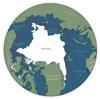
Redrawing The Arctic Map: The New North Getting To Grips With a Changing Polar Landscape <> Scientific Challenges in the Arctic: Open Water As the Ice Melts, Fresh Obstacles Confront Arctic Researchers


""The Arctic covers around 5% of the planet's surface, but it is capturing a disproportionate amount of attention. With temperatures rising at twice the global rate, the region's summer sea ice is shrinking rapidly, making access easier than ever before. At the same time, countries are racing to claim parts of the Arctic's sea floor and the vast deposits of hydrocarbons that lie beneath it.

Disappearing sea ice 


Since satellite observations started in 1979, the September sea-ice extent has declined by 12% per decade, and the past 5 years have marked the lowest on record. The ice cover is thinning (see graph), making it more vulnerable to warmer temperatures. Forecasts by climate models (see graph) suggest that summer sea ice will largely disappear in the second half of the century, but the current rate of ice loss exceeds the models' forecasts, suggesting that ice-free conditions could arrive sooner.""


http://www.nature.com/news/2011/111012/full/478172a.html

""Last month, US researchers took a 4,000-tonne gamble when they steered the Marcus G. Langseth through the Bering Strait and into the Arctic Ocean. The 72-metre research vessel was not built to plow through ice, so it had never ventured that far poleward before.

But the rules are changing quickly in the new north. Managers at the US National Science Foundation (NSF), which owns the ship, decided to send the Langseth into the Arctic after reviewing satellite images that showed that the intended survey area in the Chukchi Sea had been largely clear of ice for four of the past five summers.

In an e-mail to Nature during the cruise, its principal investigator, Bernard Coakley, said: "We are rolling the dice a bit to take her up north." But the bet paid off for Coakley, a marine geologist at the University of Alaska Fairbanks. Sea-ice coverage was at near-record lows this summer, and the Langseth — due back in dock this week — has not encountered any troubling ice.

With the Arctic warming roughly twice as fast as the rest of the globe, there is more need than ever to monitor the changing conditions there. And the retreating summer sea ice is opening up new options for scientists who want to explore the once difficult-to-reach Arctic waters, allowing them, for example, to use vessels other than icebreakers.

But the scientists are not alone. Businesses, too, are racing to exploit the Arctic — for tourism, fishing, transportation and, especially, resources such as hydrocarbons. According to the US Geological Survey, the Arctic could hold up to 30% of the world's undiscovered gas and as much as 13% of its undiscovered oil1.

Governments keen to access this wealth are stepping up their activities in the area as a prelude to claiming rights to resources in vast swathes of territory under the United Nations Convention on the Law of the Sea (UNCLOS). When Russia planted a flag on the sea bed under the North Pole in 2007, many people saw the action as a symbolic statement about the country's territorial ambitions — a view bolstered this July when Russia pledged to station two brigades permanently in the Arctic. The next month, Canada launched its annual sovereignty operation in the Arctic and claimed that it now had more military capability in the region than ever before.""

http://www.nature.com/news/2011/111012/full/478174a.html

All My Verses Chemistry 4 Conscious Eggs ********* ALCHemYEGG AUMniVERSE