Showing posts with label Technology. Show all posts

Tuesday, May 19, 2015

Patents for Mind Control Technology

""You may have thought it sucked that California’s Senate advanced a bill to do away with personal belief objections to vaccines, but at the national level, Florida Rep. Frederica Wilson has introduced the Vaccinate All Children Act of 2015 which essentially bribes all schools into vaccine compliance… and she did it wearing a funny hat. This happens to be the same person, just by the way, who said the Haiti earthquake was “a blessing.”
Fertility rates continue to drop, as studies show Millenials are the slowest to have babies than any other women in U.S. history, but of course it can’t be a combination of social engineering and slow kill. On the totally non-related (we’re sure) flipside, record numbers of couples are taking out $30,000 loans not to buy houses or fancy cars but to receive costly in vitro fertilization treatments because so many people are having problems even getting pregnant these days.
Did you know that the oil and gas industry is recycling fracking water that may have as many as 586 chemicals in it and making bank selling it to California’s drought-stricken farmers for irrigation? Yummy.
Meanwhile, there’s a huge boom in new patents for mind control technology as we officially enter the “pervasive technology age,” and even though Microsoft filed 89 in just the last year, there’s another, perhaps even more worrisome company that has them beat… Oh, and roaming chicken velociraptor hybrid death squads are also discussed.
Technology is being suppressed for reasons of national security, and Melissa talks to people on the street to see if anyone can pronounce the ingredients commonly found in our food these days.
And… more. So much of it. Thanks for tuning in!"
Please Read More Stories From Important Source:


Tuesday, March 17, 2015

Martian Astronaut Corps Underway for Trip to Mars: A Total Recall of 90's Movies Classics

""With recent news headlines proclaiming that dozens of people have been selected as finalists for a Martian astronaut corps, it might seem like a trip to this alien world might finally be close at hand.
But let's have a little reality check. What are the chances that we really will see people on the Red Planet in the next couple of decades?
Most people just don't get how hard this would be, says Mary Lynne Dittmar, an aerospace consultant in Washington, D.C. "The distances that are involved and the complexities that are involved in going and staying there are really enormous," she says.
Dittmar ticks off a list of challenges: The trip will take more than half a year, one way, and you'll need to bring a bunch of food, plus oxygen. Then there's the question of whether you can even land on a planet with such a thin atmosphere. And if people do manage to make it to the surface, the first Martians will have to cope with everything from cancer-causing radiation to dust.
"Mars has a big dust problem," Dittmar notes.
Still, a Dutch venture called Mars One has captured the public's imagination with its plan to colonize Mars by 2025. Bas Lansdorp, the group's CEO, says they've been featured in major media outlets like CNN and the New York Times. "We've been on NPR — I think twice already," Lansdorp says.
Lansdorp is a mechanical engineer by training who has worked on wind energy technology. His Mars dream started almost 20 years ago, when he was watching Dutch TV and was stunned by vivid images of the red Martian surface sent back by a NASA rover.
"For some reason that I really cannot explain, I wanted to go to Mars and build a new human settlement there," he says.
Lansdorp believes the voyage will likely pay for itself because it will be a media spectacle. Everyone in the world will want to watch the whole adventure, he says. Mars One is planning a reality TV show with sponsorships and advertising.
"We expect it's worth up to 10 Olympic Games' [worth] of media revenue, which is $45 billion," says Lansdorp.
Of course, sponsors of the Olympics can be pretty confident that their games will happen. When asked how he responds to skeptics who say that Mars One is basically just a website and a marketing plan, Lansdorp says, "I think that the people who say that really haven't paid attention to what we've achieved already."
Lots of people applied to be part of the Mars One astronaut corps — paying a fee to do so. And the group has commissioned a couple of studies from established aerospace companies.
The Mars One plan calls for first sending out a small robotic lander in 2018. Lansdorp says he can do this more cheaply than NASA. But missions like that typically cost hundreds of millions of dollars. When told that it didn't sound like he'd raised anything like that amount of money, Lansdorp replied that "we don't need that kind of money yet because we're not yet building the actual lander. But these are the kinds of investments that we're currently in negotiation for."
How much has he raised? He won't say.
Some longtime space watchers say they seriously doubt whether Mars One has the right stuff. "I just don't find it a credible proposition," says John Logsdon, a space policy specialist and professor emeritus at George Washington University.
But that doesn't mean he thinks the idea of going to Mars in the next couple of decades is a total fantasy.
"I would like to see, once again, people leave this planet and go someplace else," says Logsdon. "Whether I'll be around in the 2030s to see the first missions to Mars ... I hope so."
Getting humans to Mars in the 2030s is NASA's stated goal. The trouble, Logsdon says, is that NASA can't expect any big infusion of cash to get the job done.
In his book After Apollo? Logsdon describes a serious proposal by NASA to push for Mars after the first moon landing. Under that plan, the first missions were scheduled for the 1980s. But President Richard Nixon didn't go for an expensive, Apollo-like program aimed at Mars, and no other administration has either.
That means that NASA will have to cobble together the pieces of a Mars program on its current budget.""

Wednesday, February 25, 2015

Consumer Reports Best Car of 2015 is the Inspired Tesla S as the "Tour De Force" Performer

""Consumer Reports named the luxury electric Tesla S its top car for the second straight year, calling the market-shaking sedan a “technological tour de force.”
The annual top-10 ranking, based on independent road performance, reliability and crash tests, also gave top category honors to three Subaru models, a landmark sweep for the small Japanese maker.
But the Japanese overall won only six slots, their lowest tally since the influential consumer ratings magazine began the list 19 years ago.
Instead, three American brands — the Tesla, the Buick Regal and the Chevrolet Impala — held their own in the top 10.
“Detroit vehicles are breaking through in new categories,” said Mark Rechtin of Consumer Reports’ car ratings team.
“Many have come a long way in performance, technology, and improved reliability.”
“These are the cars that ignite the gasoline in our veins. That we trust. Respect. And love,” the magazine said.
“They also happen to score high in our reliability ratings and shine in automotive crash tests.”
The $80,000-plus plug-in Tesla again captured the magazine’s fancy as its overall top pick, and not just for the car’s market-beating 265 mile (426 kilometer) range without a charge.
Consumer Reports praised the ability to update the Tesla’s software over the Internet, and that the company surmounted early technical problems, including a handful of fires that started from objects on the road surface kicking into its underside battery pack.
With those problems aside, Consumer Reports lauded the Tesla S’s “magnificence and sheer technological arrogance.""

Clean Energy Paving The Way...

http://www.rawstory.com/rs/2015/02/tesla-tops-consumer-reports-best-car-list-for-2nd-year/

Monday, February 2, 2015

Upstart SciNet Search Engine Displays Topics/Keywords, or User “Intents” Allowing Users to Visually Discover and Research


Does the ever-increasing volume of digital information demand a more powerful search interface? One that allows for more complex queries to be formulated, and supports instances where the information being sought out is not necessarily something the user is aware of when they begin tapping on the keyboard?
Researchers at the Helsinki Institute for Information Technology in Finland think so, and they have come up with just such an interface — spinning it out as a company, Etsimo, with the aim of commercializing the technology. Etsimo has been backed by University of Helsinki funds and the Finnish government’s TEKES program. The team is now looking for investors and partners to “go global”, as they put it.


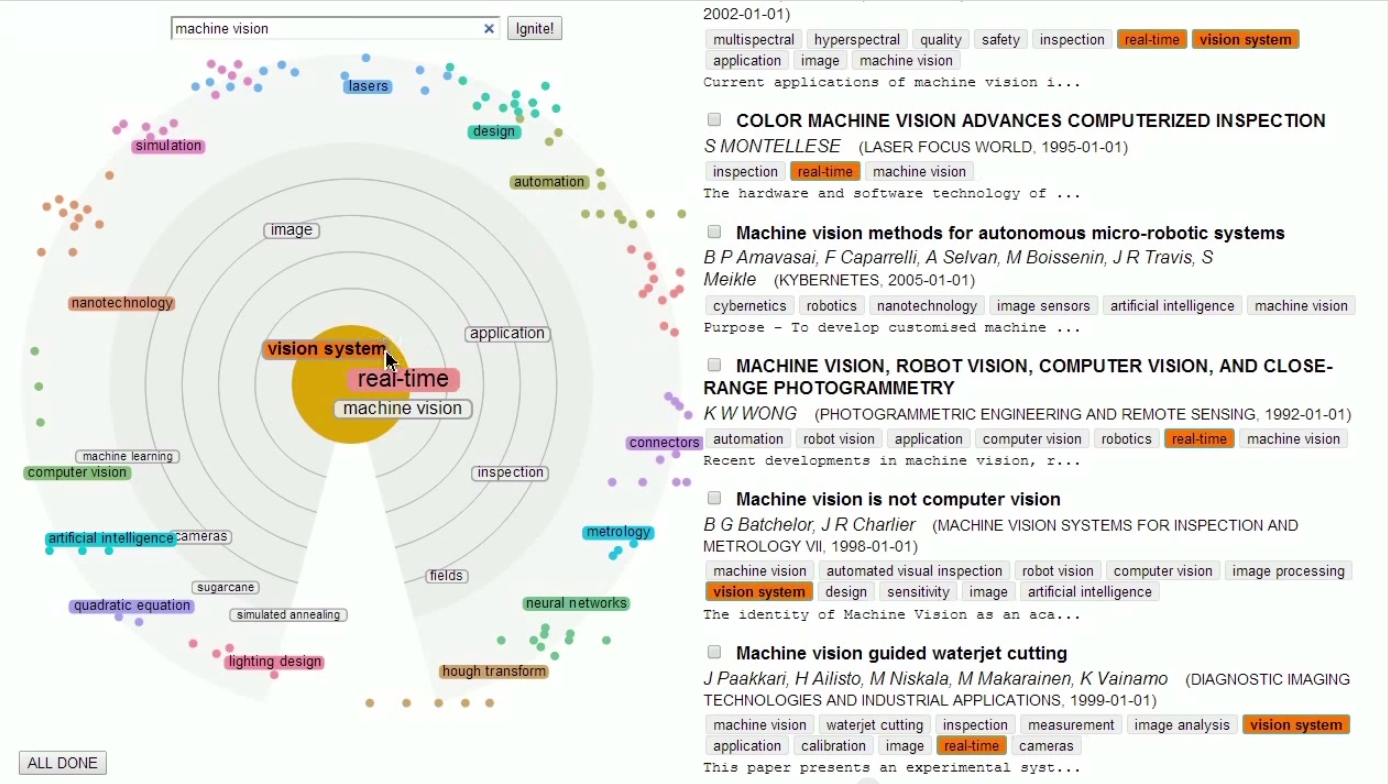
Their visual discovery search interface is called SciNet, and can be seen in action in the above video. It’s currently web-based, but a mobile version with a touchscreen interface is in the works. They have also published a paper on it in the journal Communications of the ACM.
“We started research on user intent modeling and search user interfaces in 2011 by combining the strong expertise on machine learning and human-computer interaction at our institute,” says researcher Tuukka Ruotsalo, in an interview with TechCrunch, explaining the genesis of the project.
“We decided to target search after realizing that while search engines have developed dramatically over the last decades, not much has happened to better involve humans in the search process. The role of users in search is still at best reactive: we type in few keywords and then try to make sense of results from a list of links and snippets.”
The SciNet approach to the increasingly hard problem of effective search is to involve the human user more by having them steer the algorithmic results — by signaling multiple intents as the process progresses. This generates a dynamic and visible spectrum of results — depending on what they are looking for, or interested in — and allows them to selectively drill down into complex queries in an informed, and self-guided way. The basic idea being that human-steered results are better than algorithms alone.
“We want to rely on users to make the decision and steer the search rather than only trying to build a search engine that would try to come up with a perfect answer on the first shot,” says Ruotsalo.

It’s a refreshing counter-current to the growth of algorithmic content selection being increasingly foisted on digital users (Twitter springs to mind here — albeit human content choices still remain core to its product proposition. For now).
“In cases of complex searches when even the user is uncertain about the initial query and types something in hopes to get closer to the relevant information, it is unlikely that the search engine would be able to offer a perfect result at first iteration. This is why we need to support the user to specify her information need in interaction with the search engine. Our intent modeling and visualization technology has been shown to up to double user’s performance in complex search tasks,” notes Ruotsalo.
“More specifically, we turn the search process from a memory recall task (user tries to come up with optimal keywords) to a recognition task (the computer suggests and visualizes the user with alternative search directions that user can react upon). This also makes the search process and personalization transparent for the user, the user sees what she gets and can direct the search to more suitable direction, instead of having to rely on purely algorithmic ranking, which can at worst lock the user to a filter bubble.”
The SciNet search engine displays topics/keywords, or user “intents” as it calls these potential avenues where a search may lead, on a circle — called the “intent radar”. The relevance of each keyword to the initial search query of the user (which kicks off the process, as per a normal web search) is displayed as its distance from the centre point of the radar — the closer the keyword is to the centre, the more closely related to the topic it is deemed.
This visual structure allows the user to view and browse an overview of related information, as the algorithm sees it, gathered into groups of inter-related topics. Search results related to the current intent radar are then displayed in a list at the right of the circle, tagged with the various intent keywords they relate to.


Go Ahead, Crunch Some Numbers:

Friday, January 16, 2015

Wifi RF Exposure "Appears" Greater Danger to Children's Developmental Health than to Adult's Well-being

""Forbes writer Robert J. Szczerba states he simply wants to apply common sense rules to a technology that has been -- in his view -- overlooked by manufacturers.
Manufacturers like Apple do extensively test and list detailed information about RF signals on their website - in the case of the iPhone 6 this information recommends you carry your device 5mm away from your body to maintain safe standards (1.6 watts per kilogram) as required by law in many countries.
The effects of RF and WiFi signals on adults and children have been extensively looked at elsewhere.
In the UK an independent advisory group on non-ionising radiation, headed by Professor AJ Swerdlow, produced a detailed report on RF that said there was no evidence that demonstrated "any adverse health effects of RF field exposure below internationally accepted guideline levels".
It also said that "there is increasing evidence that RF field exposure below guideline levels does not cause symptoms and cannot be detected by people, even by those who consider themselves to be sensitive to RF fields".
That review also looked at studies into RF exposure in children - particularly as it related to reaction time, rather than cancer or other illness.
It said that one 2004 study which exposed 32 children aged 10-14 in a double-blind test found no significant effects of exposure. Another 2005 study found no significant results in a similar experiment.
The report did say that "caution is needed in interpreting the effect of exposure on simple reaction time, particularly since the effect replicates those observed in earlier studies of adults".
But it also concluded that "there is no convincing evidence that RF field exposure below guideline levels causes health effects in adults or children".
Forbes notes that the study it quotes tries to link RF exposure to cancer but admits it takes 30 years on average for a tumor to develop - meaning a link (if one exists) is difficult to prove.""
Click Here to Read Beginning of Report:

Wednesday, January 7, 2015

CES 2015 Future of Intel Technology Advancements and Accelerated Computing Diversity Initiatives Revolution?


CEO Outlines Future of Computing


The Wearable Revolution

""The growth of wearable technology is creating a new playing field for innovation. Krzanich disclosed plans for the Intel Curie module1, a tiny hardware product based on the company's first purpose-built system-on-chip (SoC) for wearable devices. The module is scheduled to ship in the second half of this year and includes the Intel® Quark™ SE SoC, Bluetooth low-energy radio, sensors and battery charging.
Intel has been actively pursuing the wearable technology segment, and since Krzanich revealed several projects here last year, the company has announced multiple products and initiatives with different fashion, fitness and lifestyle brands. These efforts include Basis Peak*, Fossil Group*, Luxottica Group*, MICA and Opening Ceremony*, SMS Audio*, and the Intel "Make it Wearable" challenge.

Building on this work, Intel and Oakley today announced a strategic wearables collaboration. Oakley is the first Luxottica Group brand that Intel is working with to fuse premium, luxury and sports eyewear with smart technology. Krzanich was joined on stage by Colin Baden, CEO of Oakley, who said the companies are working on an intelligent product, available later this year, designed to enhance athletes' performance.

Krzanich also highlighted�Nixie*, the 2014 "Make it Wearable" challenge winner and the�first wearable camera that can fly. Nixie rests on your wrist like a bracelet, then unfolds and takes flight on cue to take the perfect shot of you in the moment.�Krzanich welcomed Nixie founders Christoph Kohstall and Jelena Jovanovic to the stage to discuss the Intel "Make it Wearable" challenge and highlighted the opportunity it offers to innovators and entrepreneurs. Krzanich and the founders also posed for the first Nixie flying photo. Krzanich went on to say that Intel will sponsor the Intel "Make it Wearable" challenge again later this year.


Accelerating Diversity in Technology


Krzanich, who acknowledged a recent confluence of events related to women and under-represented minorities, announced the Diversity in Technology initiative.

To support this initiative, Intel has set a bold new hiring and retention goal to achieve full representation of women and under-represented minorities at Intel by 2020. Full representation means Intel's U.S. workforce will be more representative of the talent available in America, including more balanced representation in senior leadership positions.

Intel also plans to invest $300 million to help build a pipeline of female and under-represented engineers and computer scientists; to actively support hiring and retaining more women and under-represented minorities; and to fund programs to support more positive representation within the technology and gaming industries.

"We're calling on our industry to again make the seemingly impossible possible by making a commitment to real change and clarity in our goals," said Krzanich. "Without a workforce that more closely mirrors the population, we are missing opportunities, including not understanding and designing for our own customers."

Intel plans to engage with several partners in the industry to support, enhance or create new programs for this initiative, including the International Game Developers Association*, the E-Sports League*, the National Center for Women in Technology*, the CyberSmile Foundation*, the Feminist Frequency*, and Rainbow PUSH*. The company also plans to deepen its engagement with primary education programs focused on underserved areas and expanding its collaborations with computer science and engineering programs at higher education institutions, including minority-serving institutions.


Computing Unleashed


Up until now, computing has largely been defined by human interaction with a screen, keyboard and mouse. Krzanich highlighted several new technologies and real-world applications that will usher computing into a 3-D world and also free the experience from wires and passwords.

Krzanich demonstrated a range of capabilities that will be introduced in products by the end of the year, including�True Key,�a newly announced cross-platform application by Intel Security to address the hassle of passwords.�The�True Key�application�uses personal factors like the face, device or fingerprint�to make logging in easier and safer.�True Key�is�supported on�iOS*, Android*, Windows*, Mac*, and across all your favorite�browsers. It�will also be�preinstalled on devices from HP* and Lenovo (News -Alert)* and a part of McAfee LiveSafe in the coming months. Visit www.truekey.com for access to the limited release of True Key.

Krzanich also highlighted new wireless charging collaborations including Hilton*, Jaguar Land Rover*, San Francisco International Airport* and Marriott*. These collaborators are planning wireless charging pilots, development and deployments including Marriott, which plans to pilot wireless charging capabilities across the Marriott portfolio of brands, including JW Marriott*, Marriott, Renaissance*, Courtyard* and Residence Inn*.
Intel's CEO said Intel RealSense cameras and new immersive applications can be found in a growing number of 2 in 1s, tablets, notebooks and all-in-one PCs, including many powered by the new 5th generation Intel® Core™ processors available this quarter.

As computing moves further into the third dimension, Krzanich welcomed Dion Weisler, executive vice president of HP's printer and personal system's business. Weisler discussed how HP is working to enable a blended reality ecosystem and announced that the Intel® Core™ i7 processor will power the company's forthcoming HP Multi Jet Fusion technology, engineered to resolve critical gaps in speed, quality and cost. Weisler said the added performance and scale of Intel's technology is critical to realize the full potential of 3-D printing.""


Read All Released Information in this Article: 

Tuesday, January 6, 2015

Tesla Electric Motors Boosts It's Roadster’s Existing Cell Battery and Wheel Aerodynamics Technology


Part of the Roadster’s range boost will come from using tires with less rolling resistance and from making modifications to the car’s body that improve its aerodynamics.

But the biggest improvement comes from increasing the energy density of the battery pack. Each pack contains thousands of cylindrical battery cells that look similar to AA batteries. “Cell technology has improved substantially” since Tesla designed the Roadster, the company said in its announcement. For the upgrade it will replace the original cells with new ones that store 31 percent more energy.

Though Tesla isn’t explaining in detail how it achieved the increase in energy storage, it was likely made via incremental improvements to existing battery technology, not through major breakthroughs in battery materials, says Jeff Dahn, a professor of physics and chemistry at Dalhousie University. He analyzed cells made by Panasonic, Tesla’s cell supplier, and found several small changes that might account for a 30 percent increase. For example, Panasonic has done away with some bulky plastic packaging material that had been wasting space inside the cells. He says Tesla’s battery pack could also accommodate slightly larger cells that store more energy.""


Click to Learn More:

Tuesday, October 18, 2011

Seeing Through Concrete Walls: Researchers at MIT’s Lincoln Lab Have Developed New Radar Technology That provides Real-Time Video of What’s Going on Behind Solid Walls


""The ability to see through walls is no longer the stuff of science fiction, thanks to new radar technology developed at MIT’s Lincoln Laboratory.

Much as humans and other animals see via waves of visible light that bounce off objects and then strike our eyes’ retinas, radar “sees” by sending out radio waves that bounce off targets and return to the radar’s receivers. But just as light can’t pass through solid objects in quantities large enough for the eye to detect, it’s hard to build radar that can penetrate walls well enough to show what’s happening behind. Now, Lincoln Lab researchers have built a system that can see through walls from some distance away, giving an instantaneous picture of the activity on the other side.

The researchers’ device is an unassuming array of antenna arranged into two rows — eight receiving elements on top, 13 transmitting ones below — and some computing equipment, all mounted onto a movable cart. But it has powerful implications for military operations, especially “urban combat situations,” says Gregory Charvat, technical staff at Lincoln Lab and the leader of the project. ""


http://web.mit.edu/newsoffice/2011/ll-seeing-through-walls-1018.html

Tuesday, October 11, 2011

US Crime Predicting Technology Tests Draw Minority Report Comparisons: Future Attribute Screening Technology (FAST) Programme Details Obtained Through Electronic Privacy Information Centre (Epic) - Washinton DC


""Using cameras and sensors the "pre-crime" system measures and tracks changes in a person's body movements, the pitch of their voice and the rhythm of their speech.

 It also monitors breathing patterns, eye movements, blink rate and alterations in body heat, which are used to assess an individual's likelihood to commit a crime.

 The Future Attribute Screening Technology (FAST) programme is already being tested on a group of government employees who volunteered to act as guinea pigs.

The first test was carried out at an undisclosed location in the north-eastern United States.
According to the Department of Homeland Security it was not at an airport, but was at a "large venue that is a suitable substitute for an operational setting".

 Ultimately, the system could be used not only at airports but at border crossings and any large scale public events like sports matches or political conventions.""


http://www.telegraph.co.uk/news/worldnews/northamerica/usa/8818716/US-crime-predicting-technology-tests-draw-Minority-Report-comparisons.html

All My Verses Chemistry 4 Conscious Eggs ********* ALCHemYEGG AUMniVERSE