Showing posts with label Total. Show all posts

Thursday, April 30, 2015

US Warfare State Regime Only Means Keeping Nation from Total Collapse


""The US has always been a warfare state. However, the character of US imperialist warfare has changed dramatically. For over two centuries, the US regime’s purpose for war, whether on indigenous peoples, Black people, or nations all over the world, was to expand the productive forces of capitalist exploitation. War preceded the vast profits accumulated from chattel slavery, land grab, and resource extraction in Africa, Asia, and Latin America. The foundation of white supremacy and capitalism allowed the US regime to consolidate its expansion despite episodes of periodic crisis. Recent events, alongside a steady fall in the rate of capitalist profit, indicate that US imperialist warfare no longer produces the dominance the system seeks. Now more than ever, US imperialism wages war to prevent its inevitable collapse.
US imperialism is in a state of retraction all over the globe. Cuba’s recent victory in negotiating itself off the so-called “terrorist” list is case and point. For almost six decades, Cuba’s revolution has been a beacon of hope in the midst of the misery imposed by US imperialism in Latin America. Cuba’s continued refusal to give up Assata Shakur and its socialist system, complete with free healthcare, education, and housing, has kept the island nation an enemy of the US state. Yet, beginning in December 2014, Cuba has negotiated the freedom of the Cuban 5 and struck a deal for more fraternal relations with Washington. These major victories for the Cuban revolution have setback US imperialism’s age old plan to institute a neo-colonial government. Although Cuba will always face attacks from US imperialism as long as it exists, such diplomatic victories bring much needed security in a period of hostility.
Cuba’s major gains in the diplomatic arena are emblematic of US imperialism’s decline in Latin America generally. Cuba and Venezuela’s leadership have spearheaded a movement to build an independent and integrated Latin America, especially through the institutions of UNASUR and ALBA. What once was US imperialism’s primary sphere of influence is no longer. To counter the revolt against neo-liberalism in Latin America, US imperialism has continued to pursue the overthrow of VenezuelaEcuador, and other non-aligned nations, while expanding its military reach in Africa and Asia.  In 2014, the US conducted 674 military operations throughout Africa and helped coordinate the destruction of socialist Libya in 2011. Furthermore, Washington has pursued a policy of destabilization alongside its Israeli and GCC allies,sponsoring terrorists in Syria while conducting a fraudulent war against ISIS in Iraq.
These developments are indicative of a geopolitical shift away from US hegemony. Even as US multinationals and financial banks flood the world with parasitic “markets that suck workers and nations dry, the crisis of imperialism has spurred the development of a multi-polar order. China and Russia’s increased relations along with the formation of the Asia Infrastructure Bank and BRICS have struck fear in the eyes of the shrinking US imperial economy. The War on Terror gave a facelift to US imperialism’s war of containment and plunder under these conditions. In the process, US imperialism has murdered millions in IraqAfghanistanLibyaSyriaSomalia, and has militarized the borders of Russia and China borders in an effort to forestall the emergence of a global consensus on independent development.
Iran is seen by US imperialism as a major player in the development of a multi-polar world. US imperialism’s murderous military ventures seek to isolate and eventually overthrow Iran. In fact, NATO general Wesley Clark made this explicitly clear to Democracy Now’s audience in 2007 when he stated that Washington’s imperial design for the Middle East had Iran as its target. But Iran walked away from negotiations with the US and its allies with its sovereignty intact and S-300 missile systems from Russia as added defense. It appears that US led sanctions on the Islamic Republic and its proxy war in Syria and the region has, for the time being, failed to grant imperialism its ultimate wish of Iran’s demise. And with Russia’s agreement to distribute S-300′s to the Islamic Republic, the potential military intervention to achieve said wish is significantly reduced.
Just as Ed Snowden’s revelations didn’t stop the FBI from continuing to create the so-called terrorist attacks in the US as justification for a massive surveillance state, so too does US imperialism continue its worldwide march to war despite the geopolitical shift against it. Not long after Iran agreed to the nuclear deal put forth by imperialism, Washington sent two warships to Yemen to supposedly intercept ”Iranian weapons shipments.” This is hardly representative of a move to ease relations.""

Monday, March 30, 2015

Cosmic Call of a Blood Moon Lunar Eclipse Shaping Energies of Humanity

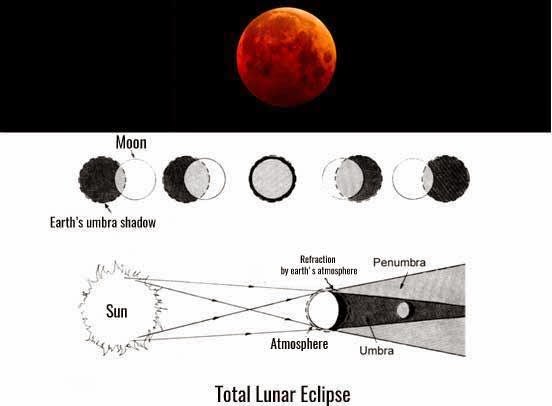
""On Saturday this week, April 4, 2015, there will be a Total Eclipse of the Moon, starting at 6 am (Note that for the eastern part of North America, the Moon will set before eclipse achieves totality). If we look at this eclipse through the cultural history of humanity, we can find that there are different things that go on when this first Full Moon of Spring is eclipsed. This is because, in many cultural traditions, Spring is regarded as the beginning of the spiritual new year. Looking into the celestial world to find the relationship between Sun and Moon and Earth every Spring was the way to find the 'cosmic call to destiny' for the coming year.


 Now in the Jewish tradition, the Spring Full Moon marks the observance and celebration of the festival of the Passover. Traditions connected with this festival have included the observance of a curfew, so that people were in the practice of not going out at night, or specifically, of not going out into the light of the Moon. When we get to the Christian tradition, we find in the New Testament description of the Last Supper, which is a Passover meal, that Judas Isacriot goes out into the night after this meal.
More specifically, he goes into the influence of the Moon,or into an eclipsing Moon, which is quite a bit different than any of the other Spring Moons. Because of this, there is a tradition of not going out into the light of the Spring Moon when it is being eclipsed, and instead to spend time in prayer and fasting. If we look into the region of the stars where we find the Sun at this time, We find that the planet Uranus is in the same field of stars. Uranus was the first planet in the history of humanity that was discovered with the use of a telescope, which means it brought something new to human experience. Because of this, Uranus has always been regarded as a herald of change. With a Total Eclipse of the Spring Moon, and the planet Uranus in the same region of the zodiac as the Sun, there certainly seems to be change on our horizon""


Tuesday, March 17, 2015

Martian Astronaut Corps Underway for Trip to Mars: A Total Recall of 90's Movies Classics

""With recent news headlines proclaiming that dozens of people have been selected as finalists for a Martian astronaut corps, it might seem like a trip to this alien world might finally be close at hand.
But let's have a little reality check. What are the chances that we really will see people on the Red Planet in the next couple of decades?
Most people just don't get how hard this would be, says Mary Lynne Dittmar, an aerospace consultant in Washington, D.C. "The distances that are involved and the complexities that are involved in going and staying there are really enormous," she says.
Dittmar ticks off a list of challenges: The trip will take more than half a year, one way, and you'll need to bring a bunch of food, plus oxygen. Then there's the question of whether you can even land on a planet with such a thin atmosphere. And if people do manage to make it to the surface, the first Martians will have to cope with everything from cancer-causing radiation to dust.
"Mars has a big dust problem," Dittmar notes.
Still, a Dutch venture called Mars One has captured the public's imagination with its plan to colonize Mars by 2025. Bas Lansdorp, the group's CEO, says they've been featured in major media outlets like CNN and the New York Times. "We've been on NPR — I think twice already," Lansdorp says.
Lansdorp is a mechanical engineer by training who has worked on wind energy technology. His Mars dream started almost 20 years ago, when he was watching Dutch TV and was stunned by vivid images of the red Martian surface sent back by a NASA rover.
"For some reason that I really cannot explain, I wanted to go to Mars and build a new human settlement there," he says.
Lansdorp believes the voyage will likely pay for itself because it will be a media spectacle. Everyone in the world will want to watch the whole adventure, he says. Mars One is planning a reality TV show with sponsorships and advertising.
"We expect it's worth up to 10 Olympic Games' [worth] of media revenue, which is $45 billion," says Lansdorp.
Of course, sponsors of the Olympics can be pretty confident that their games will happen. When asked how he responds to skeptics who say that Mars One is basically just a website and a marketing plan, Lansdorp says, "I think that the people who say that really haven't paid attention to what we've achieved already."
Lots of people applied to be part of the Mars One astronaut corps — paying a fee to do so. And the group has commissioned a couple of studies from established aerospace companies.
The Mars One plan calls for first sending out a small robotic lander in 2018. Lansdorp says he can do this more cheaply than NASA. But missions like that typically cost hundreds of millions of dollars. When told that it didn't sound like he'd raised anything like that amount of money, Lansdorp replied that "we don't need that kind of money yet because we're not yet building the actual lander. But these are the kinds of investments that we're currently in negotiation for."
How much has he raised? He won't say.
Some longtime space watchers say they seriously doubt whether Mars One has the right stuff. "I just don't find it a credible proposition," says John Logsdon, a space policy specialist and professor emeritus at George Washington University.
But that doesn't mean he thinks the idea of going to Mars in the next couple of decades is a total fantasy.
"I would like to see, once again, people leave this planet and go someplace else," says Logsdon. "Whether I'll be around in the 2030s to see the first missions to Mars ... I hope so."
Getting humans to Mars in the 2030s is NASA's stated goal. The trouble, Logsdon says, is that NASA can't expect any big infusion of cash to get the job done.
In his book After Apollo? Logsdon describes a serious proposal by NASA to push for Mars after the first moon landing. Under that plan, the first missions were scheduled for the 1980s. But President Richard Nixon didn't go for an expensive, Apollo-like program aimed at Mars, and no other administration has either.
That means that NASA will have to cobble together the pieces of a Mars program on its current budget.""

All My Verses Chemistry 4 Conscious Eggs ********* ALCHemYEGG AUMniVERSE