Showing posts with label Cosmic. Show all posts

Monday, April 20, 2015

Supervoid Found in Pool Pocket of the Universe Containing no Perceivable Light or Matter


""Astronomers from the University of Hawaii who have recently been studying what they believed was the largest detected structure in the universe have only actually found a 1.8 billion light year wide open space, not a "structure."
The Astronomers where trying to figure out why galaxies were missing from a portion of the sky being observed that was expected to have about 10,000 galaxies.

What can now be known as a "supervoid" was distinctive for its unexpected emptiness, it is "the largest individual structure ever identified by humanity,"said the studies leader István Szapudi of the University of Hawaii at Manoa.

Szapudi's research team was looking at the region that was lately found to be an area where the cosmic microwave background radiation is much cooler than the average background temperatures that surround. Astronomers have named this phenomenon a "Cold Spot."

The existence of such a large, cold area was unpredictable as most models of the evolution of the universe determine that after the Big Bang, there were some hot and cold regions in the early days of the universe, but nothing on the scale of this Cold Spot.

Researchers argue that this could be some kind of Cold Spot or empty hole because they say that their "supervoid" is sucking energy out of the cosmic radiational background that travels around it.

This supervoid is located 3 billion light years from Earth and was found in analyzing data from the Pan-STARRS1 telescope located on Maui in Hawaii and from NASA's Wide Field Survey Explorer (WISE) satellite.

The supervoid is unexpected given the usual even distribution of the universe at the scale the empty region occupies, the researchers say.

"This is the greatest supervoid ever discovered," says Kovács. "In combination of size and emptiness, our supervoid is still a very rare event. We can only expect a few supervoids this big in the observable universe.""

Monday, March 30, 2015

Cosmic Call of a Blood Moon Lunar Eclipse Shaping Energies of Humanity

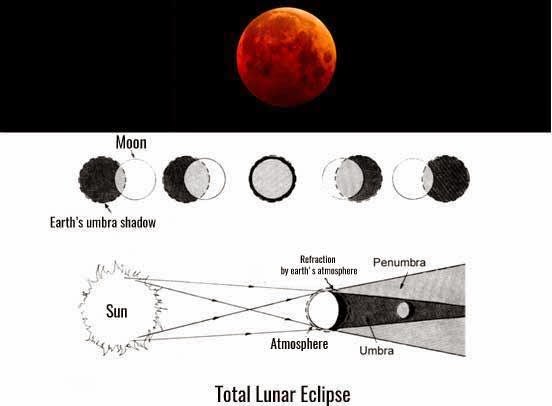
""On Saturday this week, April 4, 2015, there will be a Total Eclipse of the Moon, starting at 6 am (Note that for the eastern part of North America, the Moon will set before eclipse achieves totality). If we look at this eclipse through the cultural history of humanity, we can find that there are different things that go on when this first Full Moon of Spring is eclipsed. This is because, in many cultural traditions, Spring is regarded as the beginning of the spiritual new year. Looking into the celestial world to find the relationship between Sun and Moon and Earth every Spring was the way to find the 'cosmic call to destiny' for the coming year.


 Now in the Jewish tradition, the Spring Full Moon marks the observance and celebration of the festival of the Passover. Traditions connected with this festival have included the observance of a curfew, so that people were in the practice of not going out at night, or specifically, of not going out into the light of the Moon. When we get to the Christian tradition, we find in the New Testament description of the Last Supper, which is a Passover meal, that Judas Isacriot goes out into the night after this meal.
More specifically, he goes into the influence of the Moon,or into an eclipsing Moon, which is quite a bit different than any of the other Spring Moons. Because of this, there is a tradition of not going out into the light of the Spring Moon when it is being eclipsed, and instead to spend time in prayer and fasting. If we look into the region of the stars where we find the Sun at this time, We find that the planet Uranus is in the same field of stars. Uranus was the first planet in the history of humanity that was discovered with the use of a telescope, which means it brought something new to human experience. Because of this, Uranus has always been regarded as a herald of change. With a Total Eclipse of the Spring Moon, and the planet Uranus in the same region of the zodiac as the Sun, there certainly seems to be change on our horizon""


Thursday, January 8, 2015

Massive Millions Collection of Stars and Galaxies Released from Astronomy Database Data Now Available to the Public


"This set of observations is one of the largest astronomical databases ever assembled," remarked Donald Schneider, Distinguished Professor of Astronomy and Astrophysics at Penn State. Images are online at http://science.psu.edu/news-and-events/2015-news/SDSS1-2015


"The more than 70 terabytes we collected during the third epoch of this survey, SDSS-III, contain information on nearly half-a-billion stars and galaxies, including three-dimensional cosmic structures that formed billions of years before the sun began to shine," Schneider said. "This data release will undoubtedly form the basis for many future scientific investigations." Schneider is the SDSS-III survey coordinator and the project's scientific publication coordinator.


"The most astonishing feature of the SDSS is the breadth of groundbreaking research it enables," said SDSS-III Director Daniel Eisenstein of the Harvard-Smithsonian Center for Astrophysics. "We've searched nearby stars for planets, probed the history of our Milky Way and measured 9 billion years of our universe's accelerated expansion. Our data also provide the first direct probe of the expansion rate of the universe 10 billion years ago."

Niel Brandt, Penn State's Verne M. Willaman Professor of Astronomy and Astrophysics, is the SDSS-III leader of a number of projects investigating the properties of quasars, which are supermassive black holes that are devouring enormous amounts of matter, releasing amazing amounts energy in the process. "SDSS-III consists of four independent surveys," he said. "The fields range from searches for planets around nearby stars, to the chemical and dynamical evolution of our galaxy, to the large-scale structure of our universe."

After a decade of design and construction, the SDSS team began mapping the cosmos in 1998, using the dedicated 2.5-meter Sloan Foundation Telescope at Apache Point Observatory in New Mexico. Each phase of the project has used this telescope, which is equipped with a succession of powerful instruments, for a distinct set of astronomical surveys. SDSS-III started observations in July 2008 and completed its six-year, $45 million program in June 2014. The SDSS-III Collaboration includes 51 member institutions and 1,000 scientists from around the world.


University Released Article:

All My Verses Chemistry 4 Conscious Eggs ********* ALCHemYEGG AUMniVERSE