Showing posts with label Stars. Show all posts

Wednesday, August 5, 2015

The 2015 'September Event' a Convergence of Signs, Wonders and Hardships Ahead: Blood Moons, Shemitah, Market Crash, Revelations, Jade Helm, Climate Change, and Falling Stars

""For those old enough to remember Y2K, you may recall that there was widespread concern around the globe that the world's computer systems were not set up to convert properly to the year 2000, an unforeseen glitch many feared would crash systems that managed financial and social infrastructure.

Obviously, the collapse did not occur and, right on time, the world's computer systems joined humanity as we waltzed into the 21st century without losing modernity.

But as September approaches, some are warning of a much more provable threat – one rooted in the Jewish religion and in history – called the Shemitah Year, a 3,000-year-old mystery that is remains part of the Jewish faith.

What is the Shemitah? It is the "Sabbath year," which is also known as the sabbatical or sheviit; the seventh year of a seven-year agricultural cycle mandated by the Torah, Judaism's religious guidance, for the Land of Israel.

As reported by CBN's "The 700 Club," Shemitah "is about the events happening in America and around the world that were predicted to the time and date of occurrence" based on writings and interpretations in the Torah.

Read what others are doing to prepare for catastrophic events at preparedness.news
Religious historical reference

Some believe the Shemitah portends a "day of reckoning" for the United States.

As reported by WorldNetDaily in June, a recent U.S. Supreme Court decision allegedly hastened that day:

With the climax of the Shemitah year now just three months away on Sept. 13, America continues to saunter down the path of defiance to the will of God, say Christian leaders, inviting judgment on the land.

The latest affront to biblical sensibilities came this week when the U.S. Supreme Court ruled that Americans born in Jerusalem must not have "Israel" listed on their passports as their place of birth, saying the city remains part of disputed territory....Such a move could provoke Muslims to violence, President Obama's U.S. State Department argued, so the passport should say "Jerusalem" not "Israel." Congress took the opposite stand, and the Supreme Court ruled in favor of the executive branch.

While that may not seem important to most Americans, InvestmentWatchBlog provided further evidence that the "seventh year" is again upon us:

Rabbi Johnathan Cahn noted that the Shmitah in 2001 caused the stock market collapse at the end of September, and then in 2008 the Shmitah also caused the economy trouble. The next Shmitah happens to be at the end of the 29th day of Elul this September.

The site goes on to list a dozen other examples that seem to support the claim that another Shemitah year is upon us.

Find more prophecy articles at prophecy.news

Disturbing trends?

Carl Gallups, pastor of Florida-based Hickory Hammock Baptist Church, host of a Christian radio show and author of "Final Warning: Understanding the Trumpet Days of Revelation," agrees that time is growing short, WND reported.

"There can be no doubt that there is an amazing convergence of end-time prophecies occurring right before our eyes," he told the news site. "Think of where we are in history – Israel is back in its land – a 2,500-year-old prophecy fulfillment – Jerusalem is in the hands of Israel, the nations of the world are rallying against Israel, including the U.S., and Israel is now literally surrounded by Islamic enemies who are publicly calling for the complete destruction of the Jewish state."

There are additional signs that something is in store. First, as noted byAllNewsPipeline.comthere are a number of long-term storable food retailers experiencing a run on their products, leaving them short on some and completely out of stock on others, with restock times as long as 3-4 weeks.""


In speaking to some retailers, the site reported that the rush 
on supplies appears to be tied to "some September event."

http://www.naturalnews.com/050677_Shemitah_September_event_food_supply.html

Monday, March 30, 2015

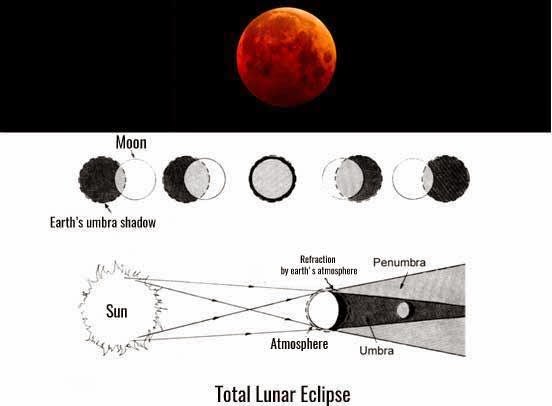
Cosmic Call of a Blood Moon Lunar Eclipse Shaping Energies of Humanity

""On Saturday this week, April 4, 2015, there will be a Total Eclipse of the Moon, starting at 6 am (Note that for the eastern part of North America, the Moon will set before eclipse achieves totality). If we look at this eclipse through the cultural history of humanity, we can find that there are different things that go on when this first Full Moon of Spring is eclipsed. This is because, in many cultural traditions, Spring is regarded as the beginning of the spiritual new year. Looking into the celestial world to find the relationship between Sun and Moon and Earth every Spring was the way to find the 'cosmic call to destiny' for the coming year.


 Now in the Jewish tradition, the Spring Full Moon marks the observance and celebration of the festival of the Passover. Traditions connected with this festival have included the observance of a curfew, so that people were in the practice of not going out at night, or specifically, of not going out into the light of the Moon. When we get to the Christian tradition, we find in the New Testament description of the Last Supper, which is a Passover meal, that Judas Isacriot goes out into the night after this meal.
More specifically, he goes into the influence of the Moon,or into an eclipsing Moon, which is quite a bit different than any of the other Spring Moons. Because of this, there is a tradition of not going out into the light of the Spring Moon when it is being eclipsed, and instead to spend time in prayer and fasting. If we look into the region of the stars where we find the Sun at this time, We find that the planet Uranus is in the same field of stars. Uranus was the first planet in the history of humanity that was discovered with the use of a telescope, which means it brought something new to human experience. Because of this, Uranus has always been regarded as a herald of change. With a Total Eclipse of the Spring Moon, and the planet Uranus in the same region of the zodiac as the Sun, there certainly seems to be change on our horizon""


Monday, March 23, 2015

Singing Stars May Be a Reality in the Universe

Scientists may have discovered the "sound" of stars by observing fluid in motion.
""A team of researchers observed the reaction of an ultra-intense laser with a plasma target, theUniversity of York reported. They noticed that a trillionth of a second after the laser strikes, plasma flowed from regions of high density to those of lower density. This event caused plasma to build up at the interface between high and low density areas, generating a sound wave.
The sound was of a frequency of more than a trillion hertz, which is six million times higher than what can be heard by any mammal.
"One of the few locations in nature where we believe this effect would occur is at the surface of stars. When they are accumulating new material stars could generate sound in a very similar manner to that which we observed in the laboratory - so the stars might be singing - but, since sound cannot propagate through the vacuum of space, no-one can hear them," said John Pasley, of the York Plasma Institute in the Department of Physics at York.
The technique used to observe this sound wave works similarly to a police speeding camera, allowing the researchers to analyze how the fluid moved when struck by the laser on a timescale of less than a trillionth of a second.

"It was initially hard to determine the origin of the acoustic signals, but our model produced results that compared [favorably] with the wavelength shifts observed in the experiment. This showed that we had discovered a new way of generating sound from fluid flows. Similar situations could occur in plasma flowing around stars," said Alex Robinson from the Plasma Physics Group at STFC's Central Laser Facility.""


Thursday, January 22, 2015

Hubble Telescope Captures 1.5 Billion-Pixel Shot of Andromeda Galaxy Stretching 48,000 Light-Years


The newly-released image stretches across about 48,000 light-years of the galaxy's disk, according to Hubble officials. In total, the image shows more than 100 million stars in the galaxy. Hubble officials revealed the new photo during a news conference here at the 225th meeting of the American Astronomical Society. [See more amazing Hubble Space Telescope photos]

"Hubble traces densely packed stars extending from the innermost hub of the galaxy, seen at left," Hubble representatives said in a statement. "Moving out from this central galactic bulge, the panorama sweeps from the galaxy's central bulge across lanes of stars and dust to the sparser outer disk."


Scientists can use this image to help them interpret other spiral galaxies like the Andromeda galaxy that might have similar light signatures, but are farther from Earth.

The panorama was created as part of the Panchromatic Hubble Andromeda Treasury (PHAT) program. This image was created as a mosaic of 7,398 exposures taken over the course of 411 pointings of the telescope, according to Hubble officials.

Click on image to see a bit more detail


Source Article:

Thursday, January 8, 2015

Massive Millions Collection of Stars and Galaxies Released from Astronomy Database Data Now Available to the Public


"This set of observations is one of the largest astronomical databases ever assembled," remarked Donald Schneider, Distinguished Professor of Astronomy and Astrophysics at Penn State. Images are online at http://science.psu.edu/news-and-events/2015-news/SDSS1-2015


"The more than 70 terabytes we collected during the third epoch of this survey, SDSS-III, contain information on nearly half-a-billion stars and galaxies, including three-dimensional cosmic structures that formed billions of years before the sun began to shine," Schneider said. "This data release will undoubtedly form the basis for many future scientific investigations." Schneider is the SDSS-III survey coordinator and the project's scientific publication coordinator.


"The most astonishing feature of the SDSS is the breadth of groundbreaking research it enables," said SDSS-III Director Daniel Eisenstein of the Harvard-Smithsonian Center for Astrophysics. "We've searched nearby stars for planets, probed the history of our Milky Way and measured 9 billion years of our universe's accelerated expansion. Our data also provide the first direct probe of the expansion rate of the universe 10 billion years ago."

Niel Brandt, Penn State's Verne M. Willaman Professor of Astronomy and Astrophysics, is the SDSS-III leader of a number of projects investigating the properties of quasars, which are supermassive black holes that are devouring enormous amounts of matter, releasing amazing amounts energy in the process. "SDSS-III consists of four independent surveys," he said. "The fields range from searches for planets around nearby stars, to the chemical and dynamical evolution of our galaxy, to the large-scale structure of our universe."

After a decade of design and construction, the SDSS team began mapping the cosmos in 1998, using the dedicated 2.5-meter Sloan Foundation Telescope at Apache Point Observatory in New Mexico. Each phase of the project has used this telescope, which is equipped with a succession of powerful instruments, for a distinct set of astronomical surveys. SDSS-III started observations in July 2008 and completed its six-year, $45 million program in June 2014. The SDSS-III Collaboration includes 51 member institutions and 1,000 scientists from around the world.


University Released Article:

Wednesday, January 7, 2015

Hardware Entering Key Test Phase for the James Webb Space Telescope Flagship Program Project

James Webb Space Telescope 

hardware entering key test phase

no alt
""An array of high tech instruments are being put through their paces ahead of becoming part of the James Webb Space Telescope (JWST). The successor to the Hubble Space Telescope – JWST engineers are currently testing hardware to ensure it will be able to function properly 1.5 million miles from Earth. The spacecraft is preparing for a launch late in 2018.

JWST:

Set for launch in October, 2018 via an Ariane 5 launch vehicle, JWST will be the scientific successor to the Hubble and Spitzer Space Telescopes.
The hugely expensive project came close to cancellation in 2011, after the program suffered with schedule slips and budget overruns. With $3 billion already spent on the JWST program, along with 75 percent of its hardware already in production, the telescope was given a stay of execution, albeit with costs capped at $8 billion.
It was originally forecast to cost just $1.6 billion.
JWSTThe project has NASA, ESA and the CSA as the lead partners, but includes a collaboration of about 17 countries in total.
To be located 1.5 million kilometers from Earth at the Earth-Sun Lagrangian point L2, JWST’s 6.5-meter diameter primary mirror – a gold coated beryllium reflector – and four specialized instruments ensure the spacecraft will provide unprecedented resolution and sensitivity from long-wavelength visible to the mid-infrared.
Unlike Hubble’s single monolithic primary mirror, JWST’s primary mirror is made up of 18 individual, adjustable segments that will be aligned in space.
2015-01-07 19_56_13-nircam1.jpg (720×653)The spacecraft’s array of instrumentation is currently being tested to ensure it can survive the extremes of space, with the most recent test involving the Near Infrared Camera (NIRCam) instrument, which is the primary imager covering the infrared wavelength range 0.6 to 5 microns.
NIRCam will detect light from the earliest stars and galaxies in the process of formation, the population of stars in nearby galaxies, as well as young stars in the Milky Way and Kuiper Belt objects.
NIRCam is equipped with coronagraphs, instruments that allow astronomers to take pictures of very faint objects around a central bright object, like stellar systems. Its coronagraphs work by blocking a brighter object’s light, making it possible to view the dimmer object nearby.
2015-01-07 19_55_13-Satnews Publishers_ Daily Satellite NewsWith the coronagraphs, astronomers hope to determine the characteristics of planets orbiting nearby stars, which is of great interest over recent years,thanks to the discoveries made by NASA’s Kepler spacecraft. ""

Find out more @ nasaspaceflight.com

Monday, October 17, 2011

Dark Matter Mystery Deepens: We Know Less About Dark Matter Than We Did Before," Asserts Lead Author Matt Walker, a Hubble Fellow at the Harvard-Smithsonian Center For Astrophysics.


"""Our measurements contradict a basic prediction about the structure of cold dark matter in dwarf galaxies. Unless or until theorists can modify that prediction, cold dark matter is inconsistent with our observational data," Walker stated.

Dwarf galaxies are composed of up to 99 percent dark matter and only one percent normal matter like stars. This disparity makes dwarf galaxies ideal targets for astronomers seeking to understand dark matter.

Walker and his co-author Jorge Peñarrubia (University of Cambridge, UK) analyzed the dark matter distribution in two Milky Way neighbors: the Fornax and Sculptor dwarf galaxies. These galaxies hold one million to 10 million stars, compared to about 400 billion in our galaxy. The team measured the locations, speeds and basic chemical compositions of 1500 to 2500 stars.

"Stars in a dwarf galaxy swarm like bees in a beehive instead of moving in nice, circular orbits like a spiral galaxy," explained Peñarrubia. "That makes it much more challenging to determine the distribution of dark matter."

Their data showed that in both cases, the dark matter is distributed uniformly over a relatively large region, several hundred light-years across. This contradicts the prediction that the density of dark matter should increase sharply toward the centers of these galaxies.

"If a dwarf galaxy were a peach, the standard cosmological model says we should find a dark matter 'pit' at the center. Instead, the first two dwarf galaxies we studied are like pitless peaches," said Peñarrubia.

Some have suggested that interactions between normal and dark matter could spread out the dark matter, but current simulations don't indicate that this happens in dwarf galaxies. The new measurements imply that either normal matter affects dark matter more than expected, or dark matter isn't "cold." The team hopes to determine which is true by studying more dwarf galaxies, particularly galaxies with an even higher percentage of dark matter.

The paper discussing this research was accepted for publication in The Astrophysical Journal and is available online.""

http://www.cfa.harvard.edu/news/2011/pr201129.html

All My Verses Chemistry 4 Conscious Eggs ********* ALCHemYEGG AUMniVERSE