Showing posts with label Research. Show all posts

Tuesday, April 14, 2015

Droughts in the West Caused by Atlantic Water Currents as Likely Culprit with Waxing and Waning of Pacific Ocean Winds

""To understand why the west has been so dry since the turn of the century, cast your eye further west—to the natural waxing and waning of Pacific Ocean winds.
Strong trade winds have been forcing heat into ocean depths, contributing to a temporary slowdown in land surface warming over the past 15 to 20 years that some have called a warming hiatus, pause, or false pause. New research published in the Journal of Climate has gone further—implicating those winds in stubborn droughts afflicting western states.
“We know there’s a lot of natural variability in the (climate) system,” Tom Delworth, a climate modeler at the Geophysical Fluid Dynamics Laboratory in Princeton, New Jersey, said. “It’s not surprising, but it’s important to understand mechanisms for this hiatus.”
Delworth and his colleagues looked at the role strong winds blowing out of the east have played in pushing warm water across the Pacific and eventually forcing it below the surface. Meanwhile, cooler-than-normal water has risen up to replace it in the eastern Pacific, a mechanism that has temporarily helped slow the rate of warming on land, despite continued global warming. (Globally, 2014 was the hottest year on record, and 13 of the hottest 15 years have been recorded since 2000.)
The ocean and atmosphere are intimately linked, so the story doesn’t just stop in the watery depth of the Pacific. Delworth’s analysis shows the precipitation deficit that has driven drought in the western US since the early 2000s is due to these changes in the Pacific region. In particular, ocean conditions have helped set up a ridge pattern that deflects storms into Canada.
If that sounds familiar, it’s because that’s what has been happening to California, the current epicenter of a decade-long western drought and victim of the ridiculously resilient ridge. But just three years ago, it was Oklahoma and Texas in the drought’s bullseye, and much of the region has dealt with some form of drought since at least 2002.
The results of the research show that 92% of the dry conditions in the west can be tied back to the trade wind shift in the Pacific, with the remainder due to humanity’s greenhouse gas pollution.
Kevin Trenberth, a climate scientist at the University Corporation for Atmospheric Research in Boulder, Colorado, said not factoring in the role of heat in driving and reinforcing drought was a major oversight in the new study. He noted recent research on the California drought, which shows how rising temperatures there have increased the odds of drought.
Delworth said that the role of human-influenced heat in drought wasn’t necessarily the aim of the study, but that it could certainly be a factor.
The results contribute to a growing body of research on the slowdown in the rise of global temperatures. Much of that work ties the phenomenon to ocean cycles, though volcanoes might also have a role to play.
“It’s the ocean hiding the heat, which would normally warm the surface,” Ka-Kit Tung, a climate modeler at the University of Washington, said. “The question is which ocean and this paper is not fully answering that question.”
Tung’s own work has pointed to the Atlantic as the main driver of the hiatus. Delworth said the Atlantic could be a possible driver of the Pacific’s weird winds, but understanding their exact cause remains “the million dollar question.""

Tuesday, March 17, 2015

Drug Companies Undermine Official Safety Warnings and FDA is Helping Them Get it Done

""It is obvious that an FDA warning about the use of a drug can scare off buyers, but according to the recent FDA's proposal, drug manufacturing companies would be able to provide doctors, hospitals and other customers with information that might conflict with the official FDA advice about their products.
This proposal has got the support of the pharmaceutical manufacturers. They claim that if the proposal is accepted, the new policy would allow them to present the doctors, the hospitals and other customers with the latest research and studies.
It might sound great, but this proposal has already gotten raised eyebrows because the public health advocates think that the drug companies can easily mislead the customers by providing only selected information from the latest studies. According to the Washington Post, most of these individual studies differ widely in their results, and many of them are funded by the industry.
The founder of Public Citizen's Health Research Group, Sidney M. Wolfe, says that "The proposal seriously undermines FDA authority. Its main supporters are drug companies and their associations, all of which would benefit from being allowed and encouraged to sell more drugs by making them seem safer than FDA has judged them to be.""

Monday, February 2, 2015

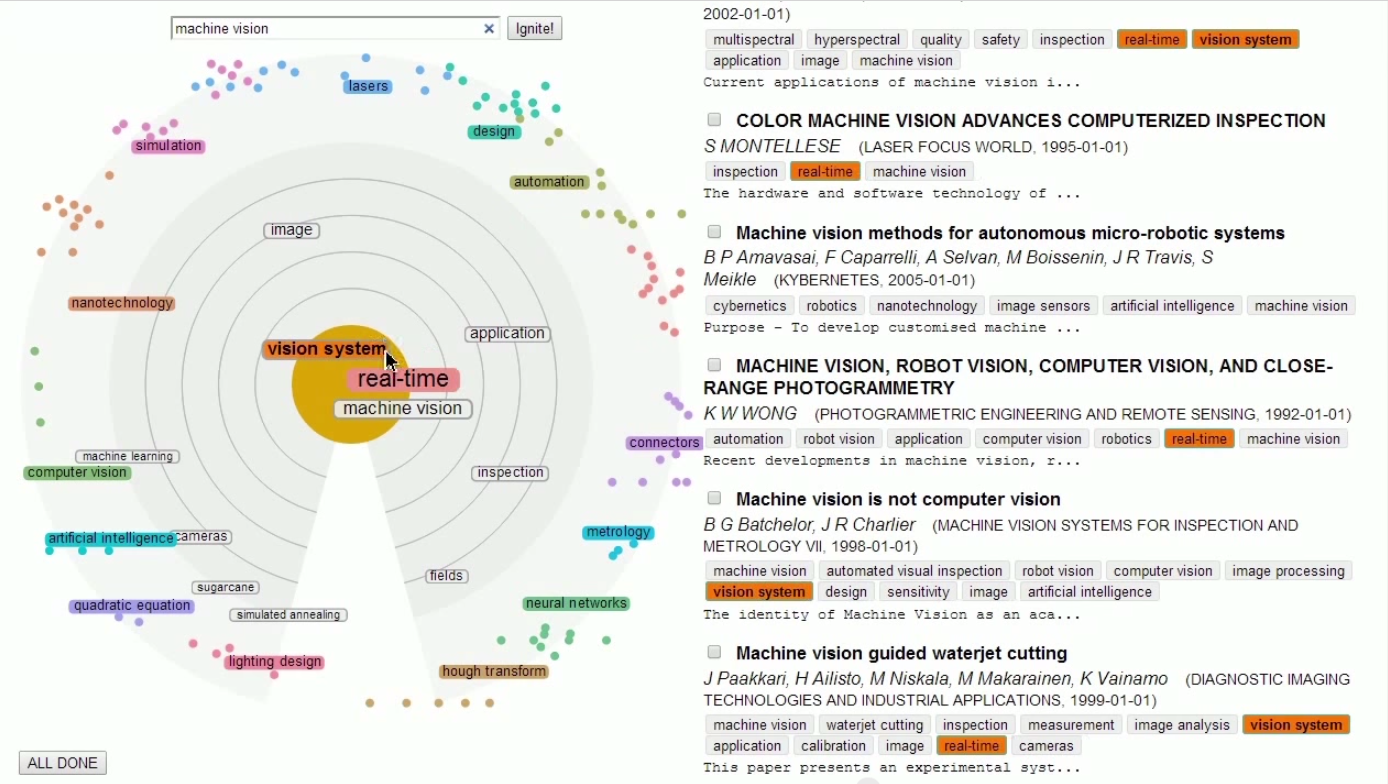
Upstart SciNet Search Engine Displays Topics/Keywords, or User “Intents” Allowing Users to Visually Discover and Research


Does the ever-increasing volume of digital information demand a more powerful search interface? One that allows for more complex queries to be formulated, and supports instances where the information being sought out is not necessarily something the user is aware of when they begin tapping on the keyboard?
Researchers at the Helsinki Institute for Information Technology in Finland think so, and they have come up with just such an interface — spinning it out as a company, Etsimo, with the aim of commercializing the technology. Etsimo has been backed by University of Helsinki funds and the Finnish government’s TEKES program. The team is now looking for investors and partners to “go global”, as they put it.


Their visual discovery search interface is called SciNet, and can be seen in action in the above video. It’s currently web-based, but a mobile version with a touchscreen interface is in the works. They have also published a paper on it in the journal Communications of the ACM.
“We started research on user intent modeling and search user interfaces in 2011 by combining the strong expertise on machine learning and human-computer interaction at our institute,” says researcher Tuukka Ruotsalo, in an interview with TechCrunch, explaining the genesis of the project.
“We decided to target search after realizing that while search engines have developed dramatically over the last decades, not much has happened to better involve humans in the search process. The role of users in search is still at best reactive: we type in few keywords and then try to make sense of results from a list of links and snippets.”
The SciNet approach to the increasingly hard problem of effective search is to involve the human user more by having them steer the algorithmic results — by signaling multiple intents as the process progresses. This generates a dynamic and visible spectrum of results — depending on what they are looking for, or interested in — and allows them to selectively drill down into complex queries in an informed, and self-guided way. The basic idea being that human-steered results are better than algorithms alone.
“We want to rely on users to make the decision and steer the search rather than only trying to build a search engine that would try to come up with a perfect answer on the first shot,” says Ruotsalo.

It’s a refreshing counter-current to the growth of algorithmic content selection being increasingly foisted on digital users (Twitter springs to mind here — albeit human content choices still remain core to its product proposition. For now).
“In cases of complex searches when even the user is uncertain about the initial query and types something in hopes to get closer to the relevant information, it is unlikely that the search engine would be able to offer a perfect result at first iteration. This is why we need to support the user to specify her information need in interaction with the search engine. Our intent modeling and visualization technology has been shown to up to double user’s performance in complex search tasks,” notes Ruotsalo.
“More specifically, we turn the search process from a memory recall task (user tries to come up with optimal keywords) to a recognition task (the computer suggests and visualizes the user with alternative search directions that user can react upon). This also makes the search process and personalization transparent for the user, the user sees what she gets and can direct the search to more suitable direction, instead of having to rely on purely algorithmic ranking, which can at worst lock the user to a filter bubble.”
The SciNet search engine displays topics/keywords, or user “intents” as it calls these potential avenues where a search may lead, on a circle — called the “intent radar”. The relevance of each keyword to the initial search query of the user (which kicks off the process, as per a normal web search) is displayed as its distance from the centre point of the radar — the closer the keyword is to the centre, the more closely related to the topic it is deemed.
This visual structure allows the user to view and browse an overview of related information, as the algorithm sees it, gathered into groups of inter-related topics. Search results related to the current intent radar are then displayed in a list at the right of the circle, tagged with the various intent keywords they relate to.


Go Ahead, Crunch Some Numbers:

Tuesday, January 13, 2015

Unbreakable Quantum Encryption Entanglement Could Change World of Data Storage According to Latest Research

""There’s a current theory, backed by numerous tests, suggesting the notion of storing data in quantum entanglement is something highly feasible, and researchers at the Australian National University (ANU) are furthering its potential.
In the past, storing data this way only lasted for a short amount of time before the quantum entanglement failed; normally in a matter of milliseconds. But now, the aforementioned Australian research team has found a way to multiply the storage time and hold data for 100 times longer.
Lead author Manjin Zhong said:
We believe it will soon be possible to distribute quantum information between any two points on the globe. Quantum states are very fragile and normally collapse in milliseconds. Our long storage times have the potential to revolutionize the transmission of quantum information.”

According to their research, they can now store data through quantum computing for up to six hours at a time. The coherence time observed is long enough that nuclear spins travelling at 9 kilometres per hour in a crystal would have a lower decoherence with distance than light in an optical fibre. This enables some very early approaches to entanglement distribution (for example for quantum cryptography) to be revisited, in particular those in which the spins are transported rather than the light.
“Our storage times are now so long that it means people need to rethink what is the best way to distribute quantum data. Even transporting our crystals at pedestrian speeds we have less loss than laser systems for a given distance.”

What is Quantum Data Storage?


In July 2014, 
Microsoft released this video explaining quantum computing to showcase how the theory works. The video dumbs down the highly complex theory and explains it succinctly, splitting quantum computing and everyday computer science into two different subway systems.The idea of quantum computing is quite difficult to understand, but computer science researchers have been studying its capabilities for years. If harnesses correctly, quantum computing is far superior to the average computing we experience today on our laptops.
Storing data through this sort of computing offers unbreakable encryption, as particles such as photons of light are created in such a way that it naturally links them together.
Matthew Sellars, leader of the research team, said:
“We have never before had the possibility to explore quantum entanglement over such long distances. We should always be looking to test whether our theories match up with reality. Maybe in this new regime our theory of quantum mechanics breaks.”""


Reality Bender Source:

Sunday, October 9, 2011

Scientist Prove DNA Can Be Reprogrammed by Words and Frequencies: Esoteric and Spiritual Teachers Have Known For Ages


THE HUMAN DNA IS A BIOLOGICAL INTERNET and superior in many aspects to the artificial one. Russian scientific research directly or indirectly explains phenomena such as clairvoyance, intuition, spontaneous and remote acts of healing, self healing, affirmation techniques, unusual light/auras around people (namely spiritual masters), mind’s influence on weather patterns and much more. In addition, there is evidence for a whole new type of medicine in which DNA can be influenced and reprogrammed by words and frequencies WITHOUT cutting out and replacing single genes.
 
Only 10% of our DNA is being used for building proteins. It is this subset of DNA that is of interest to western researchers and is being examined and categorized. The other 90% are considered “junk DNA.” The Russian researchers, however, convinced that nature was not dumb, joined linguists and geneticists in a venture to explore those 90% of “junk DNA.” Their results, findings and conclusions are simply revolutionary! According to them, our DNA is not only responsible for the construction of our body but also serves as data storage and in communication. The Russian linguists found that the genetic code, especially in the apparently useless 90%, follows the same rules as all our human languages. To this end they compared the rules of syntax (the way in which words are put together to form phrases and sentences), semantics (the study of meaning in language forms) and the basic rules of grammar. They found that the alkalines of our DNA follow a regular grammar and do have set rules just like our languages. So human languages did not appear coincidentally but are a reflection of our inherent DNA.

All My Verses Chemistry 4 Conscious Eggs ********* ALCHemYEGG AUMniVERSE