Showing posts with label When. Show all posts

Tuesday, August 4, 2015

What Happens to Your Body When You Drink a Can of Cola?: A 60 Minute Soda Bomb in Your Stomach


""Cleaning a toilet is cheap and easy with a can of Coca-Cola. After the Coke sits in the toilet for an hour, the carbonic and phosphoric acid gets the job done, leaving behind a scum-free toilet bowl!

When that same can of Coke is poured into the mouth and down the esophagus of a human being, a much more complex chain of events occurs. After burning its way down the throat and leaving behind a film of caramel coloring on the teeth, the Coca-Cola begins its nutritional destruction on the inside of the body.

In 60 minutes, a can of Coke takes the body on a roller coaster ride, taxing the liver, spiking the blood sugar, accelerating the production of bad fat and robbing the body of beneficial nutrients.

With 1.6 billion servings of Coke sold worldwide every day, it's no wonder why heart disease, malnutrition, dehydration, diabetes and obesity are slowly killing people.

Doctors often advise obese patients to stop eating fats, but many fats are good for the heart and the brain, like Omega-3 fatty acids. To top it off, simply avoiding fats disregards one of the most silent perpetrators of weight gain and disease – high fructose corn syrup.

Instead of drinking poisonous soda, drink a hydrating glass of WATER.

Soda robs the body of nutrients and burdens the liver

High fructose corn syrup (HFCS) is found in all sorts of processed foods, condiments and sweet drinks. It's even in the "low fat" alternative foods that people are conned into buying for losing weight.

The thing is this: HFCS is NOT like glucose. Glucose is recognized by the body, metabolized by the cells, and more readily used for energy, whereas HFCS breaks down into glucose and fructose, making it harder for the body to use.

The fructose that is broken down is nothing like the fructose in fruits, either. Fruits naturally have fiber to prevent the body from absorbing too much of the fructose. HFCS does not contain fiber. It floods the body with no accountability or balance, taxing the liver. HFCS is often consumed with other artificial sweetening agents that are only there to enhance a product's flavor. This flood of toxins is hard on the blood, skin and detoxifying organs.


HFCS is ultimately metabolized by the liver in similar fashion to ethanol found in an alcoholic drink. As fructose floods the liver, the liver becomes confused and ends up producing a bunch of bad fats. As the body is "intoxicated" by HFCS, the brain never receives the signal that it is full either. This may lead to a person to eating and drinking more, adding to weight gain woes.

Read other interesting articles on both toxic sweeteners like aspartame and natural sweeteners like coconut sugar at sweeteners.news

60 minutes of abuse

In the first 10 minutes of drinking a Coke, 10 teaspoons of sugar enter the body. That's 100 percent of a person's recommended daily intake. A person can only tolerate the extreme sweetness because the teeth-rotting phosphoric acid offsets the sweetness.

After 20 minutes has gone by, the blood sugar spikes, causing a burst of insulin. As the fructose runs rampant and goes unabsorbed, the liver goes into overtime, drawing in the sugar molecules and turning them into bad fats.

By the time 40 minutes hits, caffeine absorption maxes out. A person's blood pressure spikes and their pupils dilate. This spurs the liver to dump more sugar into the bloodstream. Consequentially, the brain's adenosine receptors are blocked, making the person feel awake.

Five minutes later, dopamine production goes up in the brain, giving the person feelings of pleasure that addict them into wanting more.

After an hour, the phosphoric acid that has made its way through the system has pulled out vital nutrients from the body. Calcium, magnesium and zinc bind with phosphoric acid in the lower intestine.

Calcium, magnesium, zinc, electrolytes and water are then urinated out the body and wasted. The Coke has not only addicted the brain to its curse but it has also caused the formation of bad fats, blood sugar spikes, blood pressure changes, dehydration and the loss of bone building nutrients!

As the hour climaxes, a person begins to have a sugar crash. Irritability and fatigue sets in. The bones are robbed of vital nutrients and the system is left dehydrated.""


It's 60 minutes of abuse and it 

Monday, August 3, 2015

Let's Be Clear Here, When You Deposit Money into a Bank, Legally it's Considered that Companies Money, Not Yours

""The world is awash with “promises”. Nearly everything we think of as having “value” is because of a promise behind it. A few examples; your bank accounts, retirement funds, bonds and even the dollar bills in your pocket. Your bank account for example, once you deposit the money it is no longer yours. You can argue this if you wish but we now know this is true for sure after recent “bail in” legislations passed throughout the west. When you deposit funds into a bank, it then becomes “their money” held for you …they “owe” it to you.
Do not take this lightly, lawmakers around the world have made this the new reality. A little known fact, in 1845 Britain passed banking law that made depositors (unsecured creditors), this is still precedent to this day. When you deposit money you “accept a liability” from your bank and are classified as an unsecured creditor. In other words, “get in line with everyone else”!
Same thing with many retirement accounts. Think about Social Security. When you get your annual statement form, it comes with an asterisk. This is to inform you they “might need to reduce benefits”. With any retirement account you are relying on the custodian to make payments to you upon retirement. Think about state and municipal retirement accounts promising the good life, they are nearly ALL underfunded. Meaning there is not enough money in there to make (promised) future payments unless some sort of magically higher returns are realized. These are underfunded by the TRILLIONS of dollars!
Bonds are an obvious asset class where a “promise” is relied on. Dollars on the other hand seem the most misunderstood by the public while being the biggest leap of faith in all asset classes. Dollars rely on the “full faith and credit” of the U.S. government (a bankrupt entity) yet the populace sleeps through the night secure knowing they own dollars. ALL non backed, fiat currencies in the past have failed. The dollar is the widest spread and widely owned fiat the world has ever known, its failure will be spectacular upon arrival!
I wanted to point out the above “promises” as a basis to speak about trust or confidence. The financial world turns on the axis of “trust”. This trust was nearly broken in 2008 and is the reason the Federal Reserve needed to secretly lend $16 trillion all over the world. If the Fed had not come up with these funds, failures would have spread and trust would have been broken amongst the banks/other financial institutions and even between the central banks themselves! The Fed’s largesse worked and trust was maintained.
Now, I believe we are set for another “test” of trust. We have gone five+ years with QE this and QE that, the reality being outright monetization. In fact, central banks today are buying more sovereign bonds than are even being issued. The public and even the professional funds have backed away from the debt markets, you can’t blame them because the interest received does not even cover inflation not to mention a risk premium. Globally the pace of trade and business activity is slowing or even declining which will bring to a head the difficulties in meeting debt service and other “promises”.
I ask, what will happen when inevitably “trust” begins to wane? Or even fully break? It is at this point the system goes into “The Great Call”. Margin call? Of course, because nearly everything financial has leverage behind it but there is more to it than this. The “call” I am speaking of is for contracts of all sorts to “perform”. In particular I am thinking “derivatives” contracts will be called on to perform their contractual duties.
All in all, there are over $1 quadrillion worth of derivatives outstanding. The problem with this is the “tail” is bigger than the dog. In other words, the amount of derivatives outstanding dwarfs the total amount of money outstanding and thus the ability to “pay” and make good on the contracts. The other side of this coin are contracts promising to deliver something. Here I am thinking both gold and silver. There are far more (100-1 or more) obligations outstanding than there are ounces or kilos available to deliver. This is a default just waiting to happen.
If you listen to the Harry Dents of the world, the dollar will be the safe haven and where all fear capital will go. In a world based on nothing but trust and promises, will fear capital really pile INTO a currency based ONLY on trust and promises …when “trust” is exactly what is come into question. Actually, it can be said the dollar was originally set up in 1971 on a “never pay” model. The dollar (and bonds) only promise to pay “more dollars” and nothing else. This game worked for many years, now it looks like the Saudis after doing many deals with both Russia and China may be set to transact in currency other than dollars. Are they displaying confidence?
The Chinese are now net sellers of U.S. Treasuries. Ask yourself this question, if China could sell all of their Treasuries and turn it all into gold, silver, oil, copper and other real tangible assets (without destroying the Treasury market or making gold and silver go no offer), would they? I say yes, they absolutely would love to be out from under their Treasury position. Apologetic others might say China is comfortable, we will soon see.
Because confidence is the only thing at this point holding the game together …and its fickle nature, it is important for you to think this through. What will be standing when confidence breaks? Can banks globally survive “runs” when depositors come calling? Can commodity exchanges deliver all they promise? Can borrowers “borrow more” if they cannot redeem past issues with new debt? This is where we are headed both systemically and globally!
Before finishing I want to tie two connected thoughts together. First, the great Paul Craig Roberts said last week he feared precious metals could be suppressed forever. I received MANY fearful e-mails regarding this thought process. Mr. Roberts would be entirely correct if it were not for one small detail, REAL gold and REAL silver must be available to deliver. Otherwise the game comes to an end and the fraud is exposed. He is entirely correct, “price” can be jammed or rammed with enough “margin” posted. Dan Norcini once upon a time had it correct when he said, nothing will unnerve the shorts more than the longs standing for delivery …and making a call for the product. I would like to remind you, COMEX currently has only 11.7 tons of gold for delivery. This is roughly $400 million. If I were short, this paltry sum would not add to my confidence.""


Tuesday, July 28, 2015

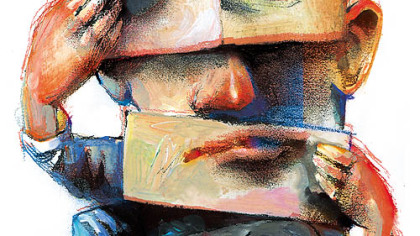
When You Don't Exist: What Happens to Your Sense Of Self?

Science journalist Anil Ananthaswamy thinks a lot about "self" — not necessarily himself, but the role the brain plays in our notions of self and existence.
In his new book, The Man Who Wasn't There, Ananthaswamy examines the ways people think of themselves and how those perceptions can be distorted by brain conditions, such as Alzheimer's disease, Cotard's syndrome and body integrity identity disorder, or BIID, a psychological condition in which a patient perceives that a body part is not his own.
Ananthaswamy tells Fresh Air's Terry Gross about a patient with BIID who became so convinced that a healthy leg wasn't his own that he eventually underwent an amputation of the limb.
"Within 12 hours, this patient that I saw, he was sitting up and there was no regret. He really seemed fine with having given up his leg," Ananthaswamy says.
Ultimately, Ananthaswamy says, our sense of self is a layered one, which pulls information from varying parts of the brain to create a sense of narrative self, bodily self and spiritual self: "What it comes down to is this sense we have of being someone or something to which things are happening. It's there when we wake up in the morning, it kind of disappears when we go to sleep, it reappears in our dreams, and it's also this sense we have of being an entity that spans time."

Interview Highlights

On how to define "self"
When you ask someone, "Who are you?" you're most likely to get a kind of narrative answer, "I am so-and-so, I'm a father, I'm son." They are going to tell you a kind of story they have in their heads about themselves, the story that they tell to themselves and to others, and in some sense that's what can be called the narrative self. ...
There are also other ways of thinking about the self. For instance, you and I right now are probably sitting on our chairs, and we have a sense of being a body that is in one place and we can feel sensations in our body. ...
We can think back to our earliest memories. We can imagine ourselves in the future, and whatever perceptions arise when we remember or when we imagine, whatever emotions arise, they again feel like they're happening to the same person. So all of these things put together, in some sense, can be called our sense of self.
On Cotard's syndrome, in which a person believes he or she is already dead
Cotard's syndrome was something that was first identified by a French doctor in the late 1800s. His name was Jules Cotard, and it's named after him. It's a constellation of symptoms ... and the most characteristic symptom is the situation where people say that they don't exist. This is a perception that they have, and you cannot rationalize, you cannot really give them evidence to the contrary and expect them to change their mind. It is a complete conviction that they have that they don't exist. ... It's very, very paradoxical. It poses a great philosophical challenge to people who are trying to understand what it means to say "I exist" or "I don't exist." It also makes you wonder about all the other things that we are certain about, like you and I probably are very certain that we exist, well, these people are just as certain that they don't. So it makes you question about perceptions that arise in the brain and somehow, in this case, the delusion is so complete and so convincing that you really cannot shake their conviction that they are dead.
On what brain imaging of a patient with Cotard'ssyndrome shows us
What seems to be happening is that there is a network in the brain that is responsible for internal awareness, awareness of our own body, awareness of our emotions, awareness of our self-related thoughts, and in Cotard's, it seems like that particular network is tamped down. In some sense, their own experience of their body, in all its vividness, in experience of their own emotions in all its vividness, that's compromised very severely. In some sense they're not feeling themselves vividly. It's as simple as that. But, then there's something else that's happening in the brain. It seems like parts of the brain that are responsible for rational thought are also damaged. First of all, what might be happening is a perception that arises in their brain saying that they are dead because they're not literally perceiving their own body and body states and emotions vividly and then that perception — irrational though it is — is not being shot down.
On body integrity identity disorder, which causes a person to believe that a body part is not his or her own
It really is a very disturbing condition in the sense that it's not something you would normally ever experience. ... If you look at your hand, there is no doubt in your mind that it is your hand. Now imagine you looked at your hand and it didn't feel like yours and it didn't feel like yours for 20, 30 years; it could be a very debilitating thing. It seems to be like that for people experiencing or suffering from BIID. They do take extreme measures. It's basically a mismatch between the internal perception they have of their own body and the physical body and what's intriguing and interesting in terms of the self is that what is most important for our sense of self, our bodily self, is the internal perception of it. You can look at your body and you can see your hand or leg that is fully functional, and yet if it doesn't feel like yours. The feeling is the much more important part of one's self, not the fact that you can see it and you can function with this leg.
On a patient with BIID 
who got his leg amputated
I talked to him a few times before the operation trying to find out what it was really that he was suffering from and he really felt like this leg, part of his leg, was not his, it was really something he didn't want. He would try a whole range of things to make it seem as if he didn't have it. He would fold his leg and pretend it wasn't there, he would push it to one side, it really seemed to ruin his life. I remember asking him once, "So what does it exactly feel like?" He says, "It feels like my soul doesn't extend into that part of my leg." ...
One way to kind of understand might be happening in BIID is actually to look at the converse problem. Most people by now will be really well aware of this phenomenon called phantom limbs [syndrome] where you actually have an amputation because of some unfortunate accident or infection and you lose an arm or a leg. Many people continue to feel that the limb still exists and some people even feel pain in that imaginary limb. What that's telling you is what you are perceiving as your limb is actually some representation of the limb in your brain, not the physical limb.

All My Verses Chemistry 4 Conscious Eggs ********* ALCHemYEGG AUMniVERSE